Harvest Hymn Questions Answers Class 8 English NCERT — Get complete and easy Harvest Hymn Questions Answers with meanings, explanations, and Exam-Based Questions for Class 8. This guide also includes a Sample Question Paper, extra practice questions, and NCERT-based solutions to help students prepare effectively and score high in exams.
I. Let us do these activities before we read (Page No 173)
1. India celebrates many harvest festivals. When is the harvest festival celebrated in your region, and how is it celebrated?
Ans: In my region, the harvest festival is celebrated during (write your month—e.g., January / November). People celebrate it by decorating their homes, cooking special traditional foods, wearing new clothes, and thanking nature for a good harvest. Many families also gather together and enjoy cultural programmes and community feasts.
(Students may write in their region’s dialect.)
2. A hymn refers to a song of praise.
(i) To whom do we offer a hymn?
Ans: We offer a hymn to God or to any divine power.
(ii) When and where do we sing a hymn?
Ans: We usually sing a hymn during prayer at home, school, temples, churches, or other places of worship.
(iii) Why do we offer it?
Ans: We offer a hymn to show devotion, gratitude, and respect to God.
[read_also url=”https://www.uptodateenglish.com/the-cherry-tree-questions-answers-class-8-ncert-english” title=”The Cherry Tree Questions Answers Class 8 NCERT English”]
POORVI: Textbook of English for Grade 8 NCERT Solution 2025-2026:
II Some poets and authors use words that are no longer a part of common usage. Such words are called archaic words. Work in pairs. Read the sentences given below. Match the underlined archaic words in Column 1 with their meanings in Column 2. Share your answers with your classmates and teacher. ‘Thou art my friend, and I trust thee. Thy kindness is great, and everything that is mine is thine.’
Ans:
| Column 1 | Column 2 | Answer |
| 1. thou | (iii) you (subject) | 1 – iii |
| 2. art | (iv) are | 2 – iv |
| 3. thee | (ii) you (object) | 3 – ii |
| 4. thy | (v) your | 4 – v |
| 5. thine | (i) yours | 5 – i |
III Work in pairs. Read the paragraph and select the correct meaning for each underlined word from the options given below. Share your answers with your classmates and teacher.
Under the golden 1. radiance of the evening sun, the villagers gathered to pay 2. tribute to their 3. cherished elder, who had dedicated his life to their well-being. His wise 4. counsel had guided generations, steering them through challenges. Known for his 5. munificent spirit, he never hesitated to share his resources generously.
1. radiance : (i) glow (ii) brilliance
2. tribute : (i) respect (ii) gratitude
3. cherished : (i) preserved (ii) loved
4. counsel : (i) advice (ii) decision
5. munificent : (i) rich (ii) generous
Ans:
1. radiance: brilliance
2. tribute: respect
3. cherished: loved
4. counsel: advice
5. munificent: generous
Summary & Word Notes:
Men’s Voices:
Harvest Hymn is a poem where the men of a village express their deep gratitude to the gods for a successful harvest. They first praise Surya, the Sun God, calling him the lord of the lotus, morning, and harvest. They thank him for the bright sunlight that helped their seeds grow and their corn ripen. Then they praise Varuna, the Rain God, for sending rain and dew that nourished their fields and valleys. The men offer songs, garlands, fruits, and the riches of their fields as a tribute to both gods. Through their joyful music of cymbals, flutes, and pipes, they celebrate the blessings of nature and acknowledge that their prosperity comes from divine mercy and support.
Word Notes:
Lotus: a beautiful water flower: कमल
Harvest: the time of gathering crops: फसल कटाई
Munificent: very generous : उदार / दयालु
Morn: morning: सुबह
Bounty: great gift or blessing : उदार उपहार / वरदान
Prospered: helped to grow or succeed : उन्नति की / फल-फूलना
Sowing: planting seeds : बुवाई
Nurtured: cared for and helped to grow : पोषित किया
Garlands: flowers tied in a chain : माला
Tribute: an offering of respect or thanks : श्रद्धांजलि / सम्मान
Mellowing: becoming soft or ripe : पकना / नरम होना
Radiance: bright light : चमक / प्रकाश
Hail: to praise or welcome : प्रशंसा करना / स्वागत करना
Cymbal: a musical instrument made of metal plates : मंजीरा
Flute: a musical instrument you blow into : बांसुरी
Rainbow: seven-coloured arc in the sky : इंद्रधनुष
Beneficent: kind, doing good : परोपकारी / शुभकारी
Main: the sea or ocean : समुद्र
Furrows: long narrow lines in a ploughed field : नाली / हल की रेखाएँ
Cherished: cared for with love : संजोया / प्यार से संभाला
Fostered: helped to develop or grow : प्रोत्साहित किया / बढ़ावा दिया
Grain: seeds of crops like wheat, rice, etc. : अनाज
Valleys: low areas between hills and mountains : घाटियाँ
Garnered: collected or gathered : संग्रह किया
Ripe: fully grown and ready to eat : पका हुआ
Dewfall: drops of water that form at night : ओस
Women’s Voices:
In Harvest Hymn, both men and women thank the divine powers of nature for a successful harvest. While the men praise Surya, the Sun God, and Varuna, the Rain God, the women offer their devotion to Prithvi, the Earth Goddess. They call her the queen of the gourd-flower and the queen of the harvest. The women acknowledge that Earth is like a loving mother whose rich soil feeds them and gives birth to all their wealth and crops. They offer love, garlands, and gifts that come from her own abundance. With cymbals and drums, they joyfully praise her as the source of their happiness. Together, the poem shows deep gratitude to the sun, rain, and earth for sustaining human life.
Word Notes:
Gourd-flower: flower of the gourd plant : लौकी का फूल
Harvest: time of gathering crops : फसल कटाई
Omnipotent: all-powerful : सर्वशक्तिमान
Plentiful: many, abundant : प्रचुर / बहुतायत
Bosom: chest; symbol of nourishment : हृदय / पोषण का स्रोत
Feeds: gives food or nourishment : खिलाती है / पोषण करती है
Womb: place where life begins : गर्भ / कोख
Riches: wealth, valuable things : धन / संपत्ति
Garlands: flowers tied in a chain : माला
Tribute: offering of respect or thanks : श्रद्धांजलि / सम्मान
Opulent: rich, full of abundance : समृद्ध / वैभवपूर्ण
Manifold: many kinds; multiple : अनेक / विविध
Gladness: happiness : खुशी / प्रसन्नता
Hail: to praise or welcome : स्वागत करना / प्रशंसा करना
Prithvi: Earth goddess : पृथ्वी देवी
Cymbal: metal musical instrument : मंजीरा
Drum: percussion instrument : ढोल / ड्रम
All Voices:
Harvest Hymn by Sarojini Naidu is a song of gratitude offered by the whole community after a successful harvest. The men thank Surya, the Sun God, for his light and Varuna, the Rain God, for giving rain and dew that helped their crops grow. The women praise Prithvi, Mother Earth, who nourishes them with her rich soil and gives birth to all their food and wealth. Finally, all voices join together to praise the Supreme Lord of the Universe, the eternal source of life. They acknowledge Him as the giver of strength, guidance, and protection. Offering their songs, garlands, and labour, the people express unity, devotion, and gratitude to all the divine powers of nature.
Word Notes:
Universe: all of space and creation : ब्रह्मांड
Being: existence or life : अस्तित्व / जीवन
Eternal: without beginning or end : शाश्वत / अनंत
Ineffable: too great to be expressed in words : अवर्णनीय / वर्णन से परे
Seed: the beginning of life; what grows into a plant : बीज
Scythe: a curved tool for cutting crops : दरांती
Harvests: gathering of crops : फसल कटाई
Labours: hard work : श्रम / मेहनत
Tribute: offering of respect or thanks : श्रद्धांजलि / सम्मान
Succour: help in times of need : सहायता / सहारा
Counsel: guidance or advice : सलाह / मार्गदर्शन
Care: protection or concern : देखभाल / संरक्षण
Blessing: divine favour or goodness : आशीर्वाद
Hail: to praise or welcome : प्रशंसा करना / स्वागत करना
Cymbal: metal musical instrument : मंजीरा
Prayer: words spoken to God : प्रार्थना
Let us discuss (Page No 176):
I Write the stanza number for the main idea of each stanza given below. Share your answers with your classmates and teacher.
Ans:
| Sl. No. | Main Idea | Stanza Number |
| 1 | The speakers recognise the lord’s kindness and praise him for nourishing the field. | Stanza 1 (Men’s Voices) |
| 2 | The speakers praise the generosity of the creator of the universe who ensures a rich harvest. | Stanza 1 (Men’s Voices) |
| 3 | The speakers devote their lives and work as a mark of respect to the lord and seek his support, wisdom, and care. | Stanza 3 (All Voices) |
| 4 | The speakers pay homage to the Earth and appreciate her role in supporting life, by dedicating their harvest. | Stanza 2 (Women’s Voices) |
II Fill in the blanks by choosing the appropriate words or phrases from within the brackets.
Ans:
1. The setting of the poem is a rural landscape, possibly during a harvest festival.
2. The tone of the poem is respectful and celebratory because it praises nature and the Lord with deep respect and gratitude.
3. In the line “Thou art our Hands and our Heart and our Home”, the letter ‘H’ is capitalised in ‘Hands’, ‘Heart’ and ‘Home’ because God resides in them.
III Identify the poetic device used in the following lines from the poem.
• Bright and munificent lord of the morn!
• We bring thee our lives and our labours for tribute
Ans:
“Bright and munificent lord of the morn!”
Poetic Device: Epithet + Alliteration
- Epithet because descriptive words (“bright”, “munificent”) are used for the lord.
- Alliteration in munificent – morn.
“We bring thee our lives and our labours for tribute.”
Poetic Device: Alliteration
- Repetition of the l sound in “lives” and “labours.”
IV Match the lines from the poem in Column 1 with their expressions in Column 2. Choose the appropriate poetic device from the box given below and write in Column 3.
| imagery, alliteration, simile, metaphor, personification. |
| Column 1 (Line from poem) | Column 2 (Expression) | Column 3 (Poetic Device) |
| 1. sweet and omnipotent mother | (iii) the earth is being given human-like qualities | Personification |
| 2. The wealth of our valleys, new-garnered and ripe | (i) creates a clear description of the scene and appeals to the senses | Imagery |
| 3. Thou art the Seed and the Scythe | (ii) implied comparison of growth and reaping with beginning and end of all life | Metaphor |
V Certain words or phrases are repeated in the same line of the poem.
For example, ‘The gold of our fields and the gold of our fruit;’ Find more such repetitions from the poem. What is the poet’s purpose of using repetition in the poem?
Ans:
Repetitions in the Poem
- “lord of the lotus, lord of the harvest”
- “Thine is the bounty… Thine is the bounty…”
- “We bring thee…” (repeated in all stanzas)
- “We praise thee…” (repeated in all stanzas)
- “O giver… we hail thee” / “O sender… we hail thee”
- “Lord of the Universe, Lord of our being”
- “Thou art…” (repeated within the same stanza)
Purpose of using repetition
The poet uses repetition to:
- Emphasise gratitude and devotion toward the divine powers.
- Create a musical and rhythmic effect, like a hymn or prayer.
- Highlight the unity of the community as they praise nature and the gods.
- Reinforce important ideas such as abundance, blessings, and the role of divine forces in the harvest.
VI The poem uses symbolism to convey deeper meanings. Match the symbols in Column 1 with the meanings they convey in Column 2.
Ans:
| Column 1 (Symbol) | Column 2 (Meaning) |
| 1. Prithvi (the Earth) | (iii) fertile land, motherhood, nurturing—the source of all life |
| 2. Surya (the Sun) | (i) light, energy, life—representing the giver of warmth and prosperity |
| 3. Varuna (Rain) | (ii) mercy and nourishment—crucial for agriculture and sustenance |
Let us think and reflect (Page No 178):
I Read the given extracts and answer the questions that follow.
1. We bring thee our songs and our garlands for tribute,
The gold of our fields and the gold of our fruit;
O giver of mellowing radiance, we hail thee,
We praise thee, O Surya, with cymbal and flute.
(i) What does the act of bringing songs and garlands as tribute suggest about the people’s relationship with the divine?
A. They fear the gods and wish to calm them in any way possible.
B. They have a deep sense of reverence and gratitude towards the divine.
C. They are forced to perform rituals without understanding the divine.
D. They depend on the gods for their daily needs and activities.
Ans: B. They have a deep sense of reverence and gratitude towards the divine.
(ii) Complete the following sentence suitably.
The word ‘gold’ in the phrases ‘the gold of our fields’ and ‘the gold of our fruit’ symbolises ________________.
Ans: the richness and abundance of their harvest.
(iii) How does the description ‘O giver of mellowing radiance’ help us understand Surya’s role in the harvest?
Ans: It shows that Surya, the Sun God, provides sunlight that ripens the crops and helps them grow, making the harvest successful.
(iv) Fill in the blank by selecting the correct option from those given in the brackets.
The use of cymbal and flute signifies _____________________________ .
Ans: joy, celebration, and musical praise offered to the gods.
2. All Voices:
Lord of the Universe, Lord of our being,
Father eternal, ineffable Om!
Thou art the Seed and the Scythe of our harvests,
Thou art our Hands and our Heart and our Home.
(i) In the phrase ‘Lord of our being,’ what does the word ‘being’ most likely refer to?
A. Our physical body
B. Our entire existence
C. Our spiritual practices
D. Our earthly possessions
Ans: B. Our entire existence
(ii) Identify whether the following statement is true or false.
The imagery of ‘the Seed and the Scythe’ symbolises the divine’s role as both the beginning (creation) and the end (harvest) of the agricultural cycle.
Ans: True
(iii) Identify the phrases from the extract that mean the following:
A. The divine as a timeless, everlasting presence
B. Beyond human comprehension or description
Ans: A. The divine as a timeless, everlasting presence → “Father eternal”
B. Beyond human comprehension or description → “ineffable Om”
(iv) How do we know that these lines from the extract are spoken as a chorus?
Ans: The repeated use of “Thou art”, “We bring thee”, and the collective address “Lord of the Universe, Lord of our being” indicate that these lines are spoken together by all voices as a chorus.
II Answer the following questions.
1. Why do the farmers hail the God of rain?
Answer: The farmers hail Varuna, the God of rain, because he sends rain and dew that nurture the crops and help them grow. His mercy fosters the grain and cherishes the furrows of the fields. By praising Varuna with cymbal and pipe, they show their gratitude for the rainfall that ensures a rich and abundant harvest.
2. What is being referred to as ‘wealth of our valleys’? Why?
Answer: The ‘wealth of our valleys’ refers to the ripened crops and fruits gathered from the fields. These represent the prosperity, sustenance, and abundance that nature provides. By calling the harvest wealth, the poem emphasises the value of the food and produce, which are essential for life, happiness, and the economic well-being of the rural community.
3. State one reason why the women refer to the Earth as a ‘source of manifold gladness’.
Ans: The women praise Prithvi, the Earth, as a ‘source of manifold gladness’ because she nurtures life and feeds them with her plentiful bosom. The Earth’s womb produces crops and wealth, offering sustenance and joy. By bringing garlands and gifts in tribute and praising her with cymbal and drum, they express happiness, gratitude, and reverence for her generosity.
4. Why does everyone in the poem offer their ‘labours for tribute’?
Ans: Everyone offers their labour for tribute as a mark of respect and devotion to the divine powers. The poem shows that the sun, rain, and earth work together to ensure a successful harvest. By offering their work, songs, and garlands, the people acknowledge the gods’ mercy and guidance, expressing gratitude and seeking continued support for life and prosperity.
5. Why has the poet presented the poem as the voices of men, women, and all voices?
Ans: The poet presents the poem in three voices to show the collective gratitude of the community. Men praise Surya and Varuna for sunlight and rain, women honour Earth for nourishment, and all voices together worship the Lord of the Universe. This division highlights unity, shared devotion, and the harmonious relationship between humans and nature during the harvest season.
6. How does the poet create the joyous atmosphere of rural India at harvesting time?
Ans: The poet creates a joyous atmosphere through imagery, music, and praise. Cymbals, flutes, and drums accompany songs and garlands offered to gods. Men, women, and all voices celebrate the ripened crops, rainfall, and sunlight. The descriptions of gold fields, fertile valleys, and plentiful harvests convey abundance and happiness, reflecting the festive spirit and gratitude of rural communities at harvest time.
7. Why is the poem presented as a hymn?
Ans: The poem is presented as a hymn because it is a song of praise and devotion. Like a traditional hymn, it expresses reverence for the gods and Earth, offers tribute in the form of songs and garlands, and highlights the sacred connection between humans and nature. The repeated praises, musical instruments, and structured voices give it a devotional, celebratory quality.
Let us learn (Page No 179):
I Match the pictures of the farming implements given in Column 1 with their use given in Column 2. Then, fill in the blanks in Column 3 to complete the name of the implement.
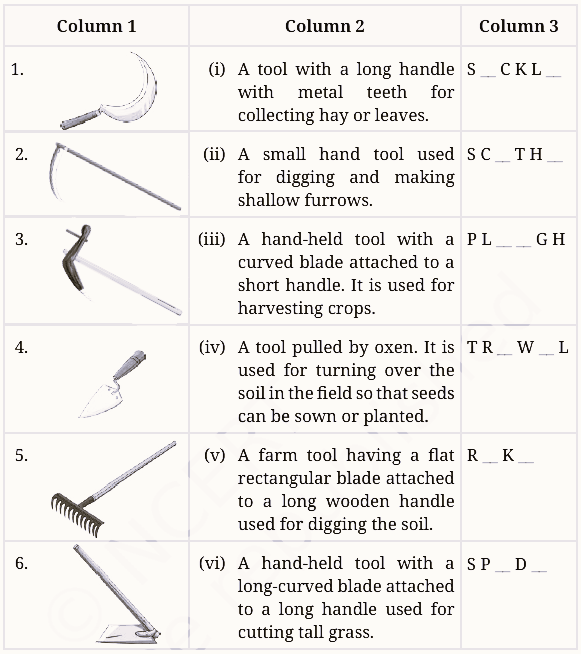
Ans:
1. SICKLE
2. SCYTHE
3. PLOUGH
4. TROWEL
5. RAKE
6. SPADE
II Choose the correct synonyms for the underlined words in the given sentences from the box below. Circle the words or phrases in the sentences that helped you to infer the meanings. One example has been done for you.
| generous, help, brightness, indescribable, kind. |
Ans:
1. The king was beneficent to the poor because he took good care of them. synonym: kind
2. He was munificent towards the needy and donated a lot for their health care. synonym: generous
3. When he lost his job, all his friends gave him succour by supporting him with money. synonym: help/support
4. When the sun’s rays came into the dark room, the whole room was full of radiance. synonym: brightness/glow
5. The little girl was speechless with ineffable joy when she got her birthday gift from her aunt. synonym: indescribable
III You have learnt about some archaic words. Some more archaic words are given below. Refer to a dictionary to find commonly used words that are similar in meaning.
1. morrow 2. hither 3. quoth 4. betwixt 5. Yonder
Ans:
| Archaic Word | Modern Equivalent / Meaning |
| morrow | tomorrow / next day |
| hither | here |
| quoth | said |
| betwixt | between |
| yonder | over there / at a distance |
Let us write (Page No 183,184):
Creative slogans are used to spread a message to capture the reader’s attention. Some examples are given below:
• Education is the Key, Unlock Your Destiny!
• Protect the Environment Today for a Better Tomorrow
• Learn, Grow, Succeed
• Go Green by Keeping the Planet Clean
Your school wishes to express gratitude to the farmers who play an important role in providing us the food on our plates. Draft a creative slogan to be put up on the school notice board.
Remember to
• focus on the main idea to be expressed
• use simple language
• be concise—express yourself in a few words
You may write the slogan on a chart paper and decorate it.
Ans:
“Thank the Farmers, Taste the Fruits of Their Hard Work!”
Other simple options:
- “Farmers Feed the Nation, Let’s Thank Them!”
- “From Farm to Plate, Farmers Make it Great!”
- “Respect the Farmers, Celebrate Their Harvest!”
You can write it in bold, colorful letters on a chart paper and decorate it with pictures of crops, tractors, and fields to make it eye-catching.
Exam-Type Questions Answers
MCQs
1. Who is referred to as the “lord of the lotus” in Men’s Voices?
A) Varuna
B) Surya ✅
C) Prithvi
D) Om
2. Which word in Men’s Voices means “generous”?
A) Beneficent
B) Munificent ✅
C) Bounty
D) Radiance
3. In Men’s Voices, Varuna is praised as the:
A) Lord of the rainbow ✅
B) Lord of the harvest only
C) Lord of the lotus
D) Lord of the universe
4. The phrase “Thine is the bounty that prospered our sowing” means:
A) The lord blesses their harvest ✅
B) The lord gives them songs
C) The lord protects the river
D) The lord controls the rain
5. Which instruments are mentioned in Men’s Voices?
A) Cymbal and flute ✅
B) Drum and pipe
C) Cymbal and drum
D) Flute and pipe
6. In Women’s Voices, Prithvi is called:
A) Queen of the harvest ✅
B) Lord of the lotus
C) Lord of the universe
D) Omnipotent Father
7. “Thine is the plentiful bosom that feeds us” refers to:
A) Generosity of the Earth ✅
B) Wealth of kings
C) Surya’s rays
D) Varuna’s rain
8. Which musical instrument is used in Women’s Voices?
A) Flute
B) Drum ✅
C) Pipe
D) Cymbal
9. “O source of our manifold gladness” praises:
A) Surya
B) Varuna
C) Prithvi ✅
D) Om
10. In All Voices, Om is described as:
A) Seed and Scythe of our harvests ✅
B) Queen of the gourd-flower
C) Lord of the rainbow
D) Lord of the lotus
11. The phrase “Grant us thy succour, thy counsel, thy care” expresses:
A) Anger
B) Request for help and guidance ✅
C) Wealth
D) Complaint
12. Which word is a synonym for “indescribable” in the text?
A) Omnipotent
B) Ineffable ✅
C) Munificent
D) Beneficent
13. The main theme of the poem is:
A) Adventure
B) Harvest and gratitude ✅
C) Love story
D) War
14. Which of the following is common in all Voices?
A) Praise of Surya only
B) Use of garlands for tribute ✅
C) Praise of Varuna only
D) Praise of Prithvi only
15. The phrase “The wealth of our valleys, new-garnered and ripe” refers to:
A) Fruits and crops of harvest ✅
B) Precious metals
C) Songs and music
D) Rivers and rain
Assertion Reason Type MCQs
1. Assertion (A): Surya is called “bright and munificent lord of the morn.”
Reason (R): He blesses the fields and nurtures the crops.
A) Both A and R are true, and R is the correct explanation of A ✅
B) Both A and R are true, but R is not the correct explanation of A
C) A is true, R is false
D) A is false, R is true
2. Assertion (A): Varuna is praised for sending rain and dew.
Reason (R): He is referred to as “lord of the rainbow” and “lord of the harvest.”
A) Both A and R are true, and R is the correct explanation of A
B) Both A and R are true, but R is not the correct explanation of A ✅
C) A is true, R is false
D) A is false, R is true
3. Assertion (A): Prithvi is called “queen of the harvest” in Women’s Voices.
Reason (R): She provides food and riches to humans.
A) Both A and R are true, and R is the correct explanation of A ✅
B) Both A and R are true, but R is not the correct explanation of A
C) A is true, R is false
D) A is false, R is true
4. Assertion (A): The use of “garlands for tribute” is found in all voices.
Reason (R): Offering garlands shows respect and gratitude to deities.
A) Both A and R are true, and R is the correct explanation of A ✅
B) Both A and R are true, but R is not the correct explanation of A
C) A is true, R is false
D) A is false, R is true
5. Assertion (A): Om is referred to as “Seed and Scythe of our harvests.”
Reason (R): Om represents the universal power controlling life and harvest.
A) Both A and R are true, and R is the correct explanation of A ✅
B) Both A and R are true, but R is not the correct explanation of A
C) A is true, R is false
D) A is false, R is true
6. Assertion (A): The poem emphasizes gratitude towards nature and deities.
Reason (R): The poets bring songs, garlands, and tributes in praise.
A) Both A and R are true, and R is the correct explanation of A ✅
B) Both A and R are true, but R is not the correct explanation of A
C) A is true, R is false
D) A is false, R is true
7. Assertion (A): “O giver of mellowing radiance, we hail thee” refers to Varuna.
Reason (R): Varuna is praised for mercy and nurturing the grain.
A) Both A and R are true, and R is the correct explanation of A
B) Both A and R are true, but R is not the correct explanation of A ✅
C) A is true, R is false
D) A is false, R is true
8. Assertion (A): “Thou art our Hands and our Heart and our Home” is said to Om.
Reason (R): Om symbolizes all creation and sustains life.
A) Both A and R are true, and R is the correct explanation of A ✅
B) Both A and R are true, but R is not the correct explanation of A
C) A is true, R is false
D) A is false, R is true
9. Assertion (A): Women’s Voices use the word “opulent” to describe Earth’s giving.
Reason (R): “Opulent” means abundant and generous.
A) Both A and R are true, and R is the correct explanation of A ✅
B) Both A and R are true, but R is not the correct explanation of A
C) A is true, R is false
D) A is false, R is true
10. Assertion (A): The poem uses musical instruments to praise deities.
Reason (R): Instruments like cymbal, flute, drum, and pipe are mentioned in the verses.
A) Both A and R are true, and R is the correct explanation of A ✅
B) Both A and R are true, but R is not the correct explanation of A
C) A is true, R is false
D) A is false, R is true
Extract-Based Questions:
Extract 1:
“Thine is the bounty that prospered our sowing,
Thine is the bounty that nurtured our corn.
We bring thee our songs and our garlands for tribute,
The gold of our fields and the gold of our fruit.”
Questions:
(i) What does the act of bringing songs and garlands as tribute suggest about the people’s attitude towards the divine?
A. They fear the gods and wish to calm them in any way possible.
B. They have a deep sense of reverence and gratitude towards the divine. ✅
C. They are forced to perform rituals without understanding the divine.
D. They depend on the gods for their daily needs and activities.
(ii) Complete the following sentence suitably.
The word ‘bounty’ in this extract refers to ________________.
Ans: the generous gifts and blessings provided by the gods, especially in the form of crops and harvest.
(iii) How does the phrase ‘the gold of our fields and the gold of our fruit’ help us understand the harvest?
Ans: It symbolises the richness, abundance, and prosperity of the crops and produce.
(iv) Fill in the blank by selecting the correct option from those given in the brackets.
The phrase “songs and garlands” shows ____________________.
Ans: joy, devotion, and respect offered to the gods.
Extract 2:
“Thine is the plentiful bosom that feeds us,
Thine is the womb where our riches have birth.
We bring thee our love and our garlands for tribute.”
Questions:
(i) What is suggested by the people bringing love and garlands to Earth?
A. They fear natural disasters.
B. They are expressing gratitude for her nurturing and generosity. ✅
C. They want to increase the fertility of the soil.
D. They are trying to control nature.
(ii) Complete the following sentence suitably.
The word ‘plentiful’ in the extract means ________________.
Ans: abundant or more than enough.
(iii) How does the description “womb where our riches have birth” help us understand Earth’s role?
Ans: It shows that Earth provides all resources, food, and wealth necessary for human survival.
(iv) Fill in the blank by selecting the correct option from those given in the brackets.
The phrase “garlands for tribute” represents ______________________.
Ans: respect, love, and gratitude towards the Earth.
Extract 3:
“Thou art the Seed and the Scythe of our harvests, Thou art our Hands and our Heart and our Home. We bring thee our lives and our labours for tribute, Grant us thy succour, thy counsel, thy care.”
Questions:
(i) What does the phrase “Seed and the Scythe of our harvests” signify?
A. The deity is only a creator.
B. The deity controls all aspects of growth and harvest. ✅
C. The deity is feared for destruction.
D. The deity protects only animals.
(ii) Complete the following sentence suitably.
The phrase “our Hands and our Heart and our Home” refers to ________________.
Ans: the deity being the source of all human effort, love, and sustenance.
(iii) How does the people’s offering of their lives and labours reflect their attitude?
Ans: It shows deep devotion, gratitude, and reliance on the divine for guidance and support.
(iv) Fill in the blank by selecting the correct option from those given in the brackets.
The request “Grant us thy succour, thy counsel, thy care” implies ___________________.
Ans: a plea for help, guidance, and protection from the divine.
Extract 4:
“O giver of mellowing radiance, we hail thee, We praise thee, O Surya, with cymbal and flute.”
Questions:
(i) What does the phrase “mellowing radiance” signify?
A. The Sun’s harmful heat
B. The Sun’s nurturing and ripening sunlight ✅
C. The moonlight
D. Darkness of night
(ii) Complete the following sentence suitably.
The people praise Surya with musical instruments because ________________.
Ans: it expresses joy, devotion, and celebration for the harvest.
(iii) How does the extract show Surya’s importance in agriculture?
Ans: It highlights that Surya provides light and warmth essential for crop growth and ripening.
(iv) Fill in the blank by selecting the correct option from those given in the brackets.
The use of “cymbal and flute” represents ___________________.
Ans: festive praise and reverence offered to the Sun God.
Extract 5:
“With gifts of thy opulent giving we come;
O source of our manifold gladness, we hail thee,
We praise thee,
O Prithvi, with cymbal and drum.”
Questions:
(i) What is meant by “opulent giving”?
A. Scarce resources
B. Abundant and generous gifts of Earth ✅
C. Musical instruments
D. Hard work of farmers
(ii) Complete the following sentence suitably.
The phrase “manifold gladness” refers to ________________.
Ans: the multiple blessings and joys that Earth provides to humans.
(iii) How do musical instruments contribute to the worship in this extract?
Ans: Cymbal and drum symbolize celebration, praise, and joyful offering to the deity.
(iv) Fill in the blank by selecting the correct option from those given in the brackets.
The extract reflects the people’s attitude of __________________.
Ans: gratitude, devotion, and respect towards Mother Earth.
Fill in the Blanks Type Questions:
1. Lord of the lotus, lord of the harvest, Bright and __________ lord of the morn.
Answer: munificent
2. Thine is the bounty that prospered our __________.
Answer: sowing
3. We bring thee our songs and our __________ for tribute.
Answer: garlands
4. O giver of mellowing __________, we hail thee.
Answer: radiance
5. Thine is the mercy that cherished our __________.
Answer: furrows
6. Queen of the gourd-flower, queen of the __________.
Answer: harvest
7. Thine is the plentiful __________ that feeds us.
Answer: bosom
8. We praise thee, O Prithvi, with __________ and drum.
Answer: cymbal
9. Thou art the Seed and the __________ of our harvests.
Answer: Scythe
10. Grant us thy succour, thy counsel, thy __________.
Answer: care
True/False Type Questions:
1. Surya is praised as the “lord of the lotus” and “bright and munificent lord of the morn.”
Answer: True
2. The people bring garlands and songs as a symbol of fear towards the gods.
Answer: False
3. Varuna is referred to as the “lord of the rainbow” and praised for sending rain and dew.
Answer: True
4. The phrase “the gold of our fields and the gold of our fruit” refers to actual gold.
Answer: False
5. Prithvi is called “queen of the harvest” and is described as omnipotent and nurturing.
Answer: True
6. The people offer their love and garlands to Earth to show gratitude and respect.
Answer: True
7. Om is described as the “Seed and the Scythe of our harvests” and the sustainer of life.
Answer: True
8. The phrase “Thou art our Hands and our Heart and our Home” shows human effort is separate from divine influence.
Answer: False
9. Musical instruments like cymbal, flute, drum, and pipe are used to express praise and celebration.
Answer: True
10. The poem emphasizes hatred and conflict between humans and nature.
Answer: False
Short Answer Type Questions:
1. Who is referred to as the “lord of the lotus” and why?
Answer: The “lord of the lotus” refers to Surya, the Sun God. He is praised for his role in nurturing the crops and ensuring a successful harvest. By providing sunlight and warmth, he helps seeds sprout, grows the corn, and sustains life, which is why the people offer songs, garlands, and gratitude as a tribute to him.
2. What does the phrase “Thine is the bounty that prospered our sowing” mean?
Answer: This phrase means that the blessings of the deity, Surya, have made the sowing successful. The seeds sown in the fields have grown into healthy crops because of his favor. The people acknowledge this divine support and express their gratitude through offerings and praise, recognizing the god’s vital role in agriculture and human survival.
3. Why do the people offer “songs and garlands for tribute”?
Answer: Offering songs and garlands shows respect, devotion, and gratitude toward the gods. It is an expression of their happiness for the bounty they have received. The tributes symbolize joy, celebration, and acknowledgement of divine generosity, showing that humans recognize the gods’ contribution to the harvest and their role in sustaining life and prosperity.
4. What is the significance of the phrase “gold of our fields and the gold of our fruit”?
Answer: The phrase symbolizes the richness and abundance of the harvest. It does not literally refer to gold but highlights the valuable crops and fruits provided by nature and the gods. It emphasizes the prosperity achieved through divine blessings, the hard work of farmers, and the fruitful outcome of their labor in the fields.
5. How is Varuna described in Men’s Voices?
Answer: Varuna is described as the “lord of the rainbow” and “great and beneficent lord of the main.” He is praised for sending rain and dew, nurturing the crops, and ensuring a successful harvest. The people offer their thanks and garlands as tribute, recognizing his mercy and the wealth of their valleys, which is a result of his benevolent influence on agriculture.
6. How is Prithvi described in Women’s Voices?
Answer: Prithvi, the Earth, is described as the “queen of the gourd-flower” and “queen of the harvest.” She is called omnipotent and nurturing, providing abundant food and wealth. The people acknowledge her as the source of happiness and sustenance. By offering love and garlands, they express their gratitude for her opulent giving, which allows them to enjoy manifold blessings.
7. What does “plentiful bosom that feeds us” mean?
Answer: The phrase refers to the nurturing and abundant nature of the Earth. It symbolizes how Earth provides food, resources, and life-sustaining wealth to humans. By describing her bosom as plentiful, the poet emphasizes the generosity and caring role of Earth in supporting human life, making her worthy of gratitude, respect, and celebratory praise.
8. Why do the people bring garlands and gifts to Prithvi?
Answer: The people bring garlands and gifts to show devotion, respect, and gratitude. These offerings symbolize their appreciation for Earth’s abundance and her role in sustaining life. Through these acts, they acknowledge her generosity and express joy for the resources, food, and wealth that she provides, celebrating her opulent giving and manifold blessings.
9. What does “womb where our riches have birth” signify?
Answer: This phrase signifies that the Earth is the source of all resources, food, and wealth. Just as a womb gives birth to life, Earth nurtures and produces the riches that humans rely on. It emphasizes the life-giving and sustaining power of nature, highlighting the people’s dependence on Earth and their reverence for her generosity and abundance.
10. How is musical praise used in Women’s Voices?
Answer: Musical praise, using instruments like cymbal and drum, is used to celebrate and honor Prithvi. Music represents joy, devotion, and reverence, enhancing the act of worship. Through rhythm and sound, the people express happiness for Earth’s blessings, making the offering of garlands and gifts more meaningful, and showing their deep emotional connection with the nurturing deity.
11. How is Om described in All Voices?
Answer: Om is described as the “Seed and the Scythe of our harvests” and the “Life of all life.” This shows that Om represents the universal power that creates, sustains, and governs life. Om is also called our Hands, Heart, and Home, symbolizing divine involvement in human effort, love, and survival, emphasizing devotion, gratitude, and dependence on the eternal deity.
12. What does “Seed and the Scythe of our harvests” mean?
Answer: This phrase signifies that Om is both the source of life (Seed) and the one who enables its harvest (Scythe). It indicates that divine power initiates creation and brings it to fruition. The people acknowledge that their labor and crops are sustained by Om’s influence, showing a recognition of the interconnection between divine guidance and human effort.
13. Why do the people offer their lives and labors as tribute to Om?
Answer: Offering their lives and labors symbolizes devotion, gratitude, and surrender to divine guidance. It reflects the understanding that all human effort is supported and blessed by Om. By dedicating their work, the people acknowledge the deity’s role in sustaining life, granting success, and providing care and counsel, showing reverence and dependence on the divine power.
14. What is the meaning of “Grant us thy succour, thy counsel, thy care”?
Answer: This phrase is a plea for help, guidance, and protection from the divine. The people seek Om’s support in their lives, asking for wisdom, mercy, and sustenance. It shows their understanding of human limitations and reliance on divine intervention for success, safety, and fulfillment, highlighting devotion, humility, and gratitude.
15. How do cymbals and prayer contribute to worship in All Voices?
Answer: Cymbals and prayer enhance the act of worship by expressing joy, devotion, and reverence. Musical instruments create a celebratory atmosphere, while prayer conveys sincere gratitude and requests for guidance. Together, they symbolize a harmonious offering of mind, heart, and action, reflecting the people’s deep respect and emotional connection with the universal deity, Om.
16. How is the concept of life and harvest interconnected in the poem?
Answer: The poem links life and harvest through divine blessings. The deities, such as Surya, Varuna, Prithvi, and Om, provide sunlight, rain, and fertile soil, enabling crops to grow. Human labor complements this divine support. By praising and offering tribute, the people acknowledge that sustenance, prosperity, and life itself depend on this harmonious connection between nature, divine power, and human effort.
17. Why is gratitude a central theme in all parts of the poem?
Answer: Gratitude is central because humans recognize that their survival, food, and prosperity come from divine and natural blessings. By offering songs, garlands, gifts, and labor, the people express appreciation for deities’ nurturing, protection, and generosity. This theme emphasizes reverence, humility, and acknowledgment of the interdependence between humans and the divine forces sustaining life and harvest.
18. How does the poem show harmony between humans and nature?
Answer: The poem shows harmony by praising deities representing Sun, Rain, Earth, and Om, acknowledging their role in nurturing crops. Humans respond with devotion, offerings, and music, reflecting respect and cooperation. This interaction demonstrates understanding, gratitude, and emotional connection, highlighting a symbiotic relationship where human effort is complemented by natural and divine support, ensuring prosperity and life.
19. Explain the symbolic meaning of “Hands, Heart, and Home” in All Voices.
Answer: “Hands, Heart, and Home” symbolize human effort, love, and sustenance under divine guidance. It shows that all human actions, emotions, and living spaces are sustained by Om’s blessing. This metaphor reflects the belief that the divine supports all aspects of life, making it complete and prosperous, while humans express gratitude through labor, devotion, and worship.
20. How do the musical instruments used in the poem enhance its message?
Answer: Musical instruments such as cymbals, flute, drum, and pipe express joy, devotion, and celebration. They emphasize emotional engagement, making offerings and praises more meaningful. Through rhythm and sound, worshippers show respect and happiness for the deities’ generosity. The instruments enhance the theme of gratitude, the connection between humans and divine forces, and the celebration of harvest and life.
Long Answers Type Questions:
1. How does the poet use imagery to describe Surya in Men’s Voices?
Answer: The poet uses vivid imagery to portray Surya as the “lord of the lotus” and “bright and munificent lord of the morn.” Words like “mellowing radiance” and “gold of our fields” highlight the sun’s role in nurturing crops and ensuring the prosperity of the harvest. The imagery emphasizes warmth, light, and abundance, showing the connection between divine blessings and agricultural success. By describing Surya with these luminous and precious qualities, the poet creates a sense of awe and reverence. The offerings of songs and garlands reflect human gratitude, demonstrating how people acknowledge the importance of natural and divine forces in sustaining life and prosperity.
2. Explain the significance of rain and mercy in the worship of Varuna.
Answer: Varuna, described as the “lord of the rainbow” and “great and beneficent lord of the main,” represents water and rainfall essential for crops. Phrases like “Thine is the mercy that cherished our furrows” and “Thine is the mercy that fostered our grain” highlight the importance of water in agriculture. Rain symbolizes divine care, nurturing, and sustenance. By praising Varuna and offering garlands, the people show gratitude for this life-giving force. The extract emphasizes the interdependence of humans and nature, showing that blessings such as rain are not taken for granted. Competency-wise, it teaches students to appreciate natural resources and the role of divine or environmental forces in supporting human life.
3. How do the offerings of songs and garlands reflect human emotions and values?
Answer: Offering songs and garlands is a symbolic act of devotion, gratitude, and celebration. It reflects emotions of joy, reverence, and respect for divine forces like Surya and Varuna. These offerings signify acknowledgment of human dependence on nature and gods for sustenance. Competency-based learning is highlighted here, as students can relate to cultural and moral values, such as expressing gratitude, celebrating abundance, and recognizing interdependence. Through this act, the poem emphasizes that material wealth is linked with spiritual acknowledgment, showing that humans value both physical and divine blessings. Musical accompaniment further enhances the emotional depth, making worship an integrated experience of art, devotion, and morality.
4. Discuss how Prithvi is portrayed as a nurturing and omnipotent figure.
Answer: In Women’s Voices, Prithvi, the Earth, is depicted as “queen of the gourd-flower” and “queen of the harvest,” emphasizing her power, nurturing ability, and importance. Descriptions such as “plentiful bosom that feeds us” and “womb where our riches have birth” symbolize abundance, fertility, and life-giving capability. She is omnipotent because all resources, wealth, and sustenance originate from her. Competency-wise, this helps students understand environmental and moral literacy, emphasizing respect for nature. The offerings of love, garlands, and musical praise illustrate human gratitude and reverence. By portraying Earth as both powerful and nurturing, the poem teaches the importance of harmony with nature, ethical responsibility, and recognition of the interconnection between humans and their environment.
5. What is the role of music in the worship of Prithvi?
Answer: Music, represented by cymbals and drums, plays a crucial role in expressing joy, devotion, and celebration toward Prithvi. It transforms worship into a multisensory experience, combining sound, rhythm, and ritual. Competency-wise, students learn to appreciate cultural and aesthetic dimensions in literature. Musical praise strengthens emotional engagement, showing that humans celebrate nature’s generosity not only through offerings but also through art. The extract conveys that gratitude can be expressed creatively, linking ethical and aesthetic literacy. Music symbolizes collective harmony, human happiness, and respect for the abundance provided by Earth, reinforcing the connection between spiritual, emotional, and environmental awareness.
6. How does the poem emphasize human dependence on natural resources?
Answer: The poem repeatedly highlights human reliance on natural forces such as Sun, rain, and Earth. Surya provides sunlight to ripen crops, Varuna sends rain to nourish fields, and Prithvi sustains life through fertile soil and abundance. The people’s offerings, garlands, songs, and music indicate acknowledgment of this dependence. Competency-based understanding teaches students environmental awareness, moral values, and responsibility toward nature. By depicting these forces as divine, the poem emphasizes reverence, sustainability, and gratitude. Students can relate the symbolic depiction to real-life environmental practices, understanding that survival and prosperity depend on careful management, respect, and appreciation of natural resources.
7. Explain the symbolism of “Seed and the Scythe” in All Voices.
Answer: The phrase “Seed and the Scythe of our harvests” symbolizes creation, growth, and completion. The Seed represents origin and potential, while the Scythe signifies harvesting and fruition. Om, as the eternal divine power, ensures the beginning and end of life cycles. Competency-wise, students learn to interpret metaphors and understand holistic views of life, showing how divine forces and human effort combine to produce results. This highlights the interdependence between humans and the universe, encouraging reflection on labor, devotion, and sustainability. The poem teaches the balance between effort, nature, and divine blessing, making it both spiritually and practically meaningful.
8. How does the poem integrate ethical and spiritual teachings through All Voices?
Answer: The poem integrates ethical and spiritual teachings by portraying humans as dependent on divine forces for sustenance, guidance, and protection. Phrases like “Grant us thy succour, thy counsel, thy care” show humility, gratitude, and ethical awareness. Competency-based learning includes understanding moral values, environmental responsibility, and devotion. The poem encourages students to act ethically, respect nature, and recognize the importance of guidance and support in life. Through collective praise and offerings, it conveys community values, ethical behavior, and spiritual reflection, emphasizing that humans should be responsible, grateful, and harmonious in their relationship with the divine and the natural world.
9. How are human efforts and divine blessings portrayed together in the poem?
Answer: Human efforts, such as sowing, harvesting, and offering tribute, are portrayed as incomplete without divine blessings. Surya, Varuna, Prithvi, and Om provide sunlight, rain, fertility, and guidance. Competency-wise, students understand the integration of effort and external support. The poem teaches that success is a combination of personal labor and external assistance, whether divine or natural. By showing cooperation between humans and deities, it emphasizes responsibility, gratitude, and humility. It also conveys a broader life lesson: prosperity, growth, and fulfillment are possible only when human work aligns with natural laws and ethical, spiritual, and moral understanding.
10. Discuss how the poem can inspire students to appreciate nature and hard work.
Answer: The poem inspires appreciation for nature and hard work by highlighting the role of Sun, rain, Earth, and human labor in producing harvests. Surya and Varuna’s blessings, Prithvi’s abundance, and Om’s guidance show that survival depends on cooperation between humans and the environment. Competency-based learning emphasizes ecological awareness, moral responsibility, and ethical values. By showing devotion, gratitude, and celebration of harvest, students understand the value of effort, patience, and respect for natural resources. The poem motivates them to work diligently, value nature, and maintain harmony with the environment, fostering practical life skills alongside literary and ethical understanding.
GRAMMAR & WRITING
1. Choose the correct synonyms for the underlined words in the given sentences from the box below. Circle the words or phrases in the sentences that helped you to infer the meanings. One example has been done for you. [bold + underline the clue words/phrases to show what students would “circle.”]
| cherished, nurtured, opulent, fostered, tribute, eternal, labour, ripe, plentiful, manifold |
1. The farmer carefully nurtured the young plants until they grew strong.
Clue: …………..
Synonym: …………….
Ans: Clue: grew strong
Synonym: cared for / looked after
2. The villagers offered fruits and flowers as tribute to the deity during the harvest festival.
Clue: …………..
Synonym: …………….
Ans: Clue: offered fruits and flowers
Synonym: offering/gift
3. The earth’s plentiful gifts ensure that all living beings can survive.
Clue: …………..
Synonym: …………….
Ans: Clue: all…can survive
Synonym: abundant/bountiful
4. The rainwater cherished the dry fields and made them fertile again.
Ans: Clue: made them fertile again
Synonym: nourished/refreshed
5. The valleys were full of ripe grain ready to be harvested.
Clue: …………..
Synonym: …………….
Ans: Clue: ready to be harvested
Synonym: mature/ready
6. The goddess is praised for her opulent giving to humankind, providing rich gifts.
Clue: …………..
Synonym: …………….
Ans: Clue: rich gifts
Synonym: rich/abundant
7. The blessings of the Lord are eternal and never come to an end.
Clue: …………..
Synonym: …………….
Ans: Clue: never come to an end
Synonym: everlasting/endless
8. The farmers labour from morning till evening, working very hard for the harvest.
Clue: …………..
Synonym: …………….
Ans: Clue: working very hard
Synonym: hard work/toil
9. The rains fostered the growth of the new crops by helping them grow.
Clue: …………..
Synonym: …………….
Ans: Clue: helping them grow
Synonym: encouraged/promoted
10. The earth provides manifold blessings, meaning many kinds of gifts for life.
Clue: …………..
Synonym: …………….
Ans: Clue: many kinds
Synonym: many/numerous
11. The worshippers praised the beneficent lord who was kind and caring towards all beings.
Clue: …………..
Synonym: …………….
Ans: Clue: kind and caring
Synonym: kind / benevolent
12. The sun’s radiance filled the sky with bright, glowing light in the early morning.
Clue: …………..
Synonym: …………….
Ans: Clue: bright glowing light
Synonym: brightness/glow
13. The villagers offered thanks for the bounty of nature that gave them plenty of food.
Clue: …………..
Synonym: …………….
Ans: Clue: gave them plenty of food
Synonym: abundance/plenty
14. The people hailed the mellowing radiance of the sun that softened the fields with warmth.
Clue: …………..
Synonym: …………….
Ans: Clue: softened the fields
Synonym: softening / gentle
15. The earth is called the omnipotent mother because she has great power to create life.
Clue: …………..
Synonym: …………….
Ans: Clue: great power to create life
Synonym: all-powerful
2. Match the Archaic words with their Modern meaning in A table.
| A: Archaic Word | B: Modern Meaning |
| 1. morrow | a. before |
| 2. hither | b. no |
| 3. quoth | c. tomorrow |
| 4. betwixt | d. said |
| 5. yonder | e. towards here |
| 6. ere | f. over there / that place |
| 7. thou | g. you (subject) |
| 8. thee | h. you (object) |
| 9. nay | i. between |
| 10. oft | j. often |
Answer Key
1. morrow → c. tomorrow
2. hither → e. towards here
3. quoth → d. said
4. betwixt → i. between
5. yonder → f. over there / that place
6. ere → a. before
7. thou → g. you (subject)
8. thee → h. you (object)
9. nay → b. no
10. oft → j. Often
3. Identify the poetic device used in the following lines from the poem.
(a) “Lord of the lotus, lord of the harvest,”
Ans: Poetic Device: Repetition + Alliteration
Repetition of “lord of the…”
Alliteration in “lord” and “lotus.”
(b) “Thine is the bounty that prospered our sowing,”
Ans: Poetic Device: Personification
“Bounty” is given the human ability to “prosper” the sowing.
(c) “O giver of mellowing radiance, we hail thee,”
Ans: Poetic Device: Epithet
“Giver of mellowing radiance” is a descriptive epithet for Surya.
(d) “Lord of the rainbow, lord of the harvest,”
Ans: Poetic Device: Repetition
The phrase “lord of the” is repeated for emphasis and rhythm.
(e) “Thine is the mercy that fostered our grain.”
Ans: Poetic Device: Personification
“Mercy” is shown as fostering or caring for grain like a living being.
(f) “Queen of the gourd-flower, queen of the harvest,”
Ans: Poetic Device: Repetition + Epithet
Repetition of “queen of the…”
“Queen” is an epithet for Earth, giving her a royal, nurturing identity.
(g) “Thine is the plentiful bosom that feeds us,”
Ans: Poetic Device: Metaphor
Earth’s fertility is compared to a “plentiful bosom.”
(h) “O source of our manifold gladness, we hail thee,”
Ans: Poetic Device: Epithet
“Source of our manifold gladness” describes Earth with a poetic title.
(i) “Thou art the Seed and the Scythe of our harvests,”
Ans: Poetic Device: Metaphor
God is compared to both the “Seed” (beginning) and “Scythe” (end) of life.
(j) “O Life of all life and all blessing, we hail thee,”
Ans: Poetic Device: Hyperbole + Epithet
Exaggeration that God is the “Life of all life.”
An epithet used to address God with a descriptive title.
4. Draft a Slogan
1. Your school wants to encourage students to save water and protect this precious resource. Write a catchy slogan for the school notice board that motivates everyone to conserve water.
Answer (Slogan):
“Save Water Today, Secure Life Tomorrow!”
2. Your school wants to spread awareness about keeping the campus clean. Write a short and creative slogan for the notice board.
Answer (Slogan):
“Keep the Campus Clean, Keep Your Future Green!”
3. Your school wishes to promote reading habits among students. Draft a catchy slogan for the library board.
Answer (Slogan):
“Read More, Know More, Grow More!”
4. Your eco club wants students to reduce plastic use. Write a slogan to encourage eco-friendly habits.
Answer (Slogan):
“Say No to Plastic, Yes to Our Planet!”
5. Your school wants students to follow traffic rules. Create a slogan for the safety board.
Answer (Slogan):
“Follow Traffic Rules, Reach Home Safe!”
6. Your school wants to motivate students to focus on physical fitness. Draft a catchy slogan.
Answer (Slogan):
“Stay Fit, Stay Strong, Live Long!”
7. Your class is preparing a board on kindness and good behaviour. Write a slogan encouraging kindness.
Answer (Slogan):
“Choose Kindness—It Always Comes Back!”
8. To promote punctuality, the school wants a short slogan. Write one.
Answer (Slogan):
“Be on Time—Success Will Follow!”
9. Your science club wants to inspire students to plant more trees. Write a creative slogan.
Answer (Slogan):
“Plant a Tree Today, Let the Earth Breathe Tomorrow!”
10. To support mental health, the school wants a positive slogan. Draft one.
Answer (Slogan):
“A Calm Mind Is a Powerful Mind!”
11. Your school wants to raise awareness about waste management and recycling. Write a slogan.
Answer (Slogan):
“Reduce, Reuse, Recycle—For a Cleaner Tomorrow!”
Sample Question Paper
Sample Question Paper – Set 1
A. Multiple Choice Questions
1. Who is described as the “giver of mellowing radiance” in the poem?
(a) Prithvi (b) Surya (c) Varuna (d) Om
2. The women’s voices mainly praise—
(a) Water (b) Earth (c) Grain (d) Wind
3. The villagers honour Surya primarily for—
(a) Sending rainfall (b) Nurturing their corn (c) Giving medicinal plants (d) Protecting their livestock
4. The phrase “Father eternal” refers to—
(a) A village elder (b) A farmer (c) The supreme divine power (d) The sun god
5. What do the garlands symbolize in the poem?
(a) Wealth (b) Respect and devotion (c) Entertainment (d) Celebration of victory
B. Fill in the Blanks
1. The men’s voices praise Surya with cymbal and ________.
2. The women bring their ________ as a tribute to Earth.
3. The poem personifies Earth as a ________ mother.
4. All voices together hail the ________ of all life.
6. Surya is described as the lord of the ________.
C. State True or False
1. The poem highlights gratitude towards nature’s gifts.
2. Only men perform rituals in the poem.
3. Earth is described as the source of nourishment.
4. The poem uses musical imagery to enhance its festive tone.
5. The final stanza praises only Surya.
D. Very Short Answer Type Questions
1. Name the natural element that nurtures the villagers’ corn.
2. Who is addressed as “sweet and omnipotent mother”?
3. What do the villagers offer besides songs?
4. What does the word “succour” suggest in the poem?
5. Which deity is thanked for sending rain?
E. Short Answer Type Questions
1. Why do villagers express gratitude to Surya and Varuna?
2. How is Earth portrayed in the women’s chorus?
3. What role do offerings play in the poem?
4. Explain the use of personification in any one stanza.
5. How does the poem reflect the farming community’s dependence on nature?
Long Answer Type Questions
1. Describe how the poet presents the harmony between humans and nature.
2. Explain how the men’s and women’s voices complement each other.
3. Discuss the spiritual tone of the final stanza.
4. Evaluate the significance of harvest imagery in the poem.
5. How does Sarojini Naidu highlight the idea of divine gratitude through rituals?
Sample Question Paper – Set 2
A. Multiple Choice Questions
1. Which deity is associated with rain in the poem?
(a) Surya (b) Om (c) Varuna (d) Prithvi
2. The word “munificent” means—
(a) brave (b) generous (c) weak (d) fearful
3. Earth is symbolically referred to as—
(a) Warrior (b) Teacher (c) Mother (d) Leader
4. What do the villagers bring as tribute?
(a) Gold coins (b) Garland and songs (c) Weapons (d) Tools
5. Which musical instrument is mentioned in the poem?
(a) Violin (b) Flute (c) Guitar (d) Harp
B. Fill in the Blanks
1. Earth is described as the ________ of our riches.
2. The villagers thank the divine powers for fostering their ________.
3. “Lord of the rainbow” refers to ________.
4. The poem describes Om as ________ eternal.
5. The wealth of the valleys is newly ________.
C. State True or False
1. The poem celebrates the cycle of nature and harvest.
2. Varuna is praised for nurturing corn.
3. The villagers bring offerings as part of their gratitude.
4. Only women participate in praising the divine.
5. The poem has a devotional tone.
D. Very Short Answer Type Questions
1. Name the instrument used while praising Surya.
2. Who nurtures the furrows according to the poem?
3. What is Earth called at the beginning of the women’s stanza?
4. What does “garland” symbolize in the poem?
5. Name the universal lord addressed in the final stanza.
E. Short Answer Type Questions
1. How does the poet show the villagers’ dependence on divine forces?
2. What is the purpose of the musical references in the poem?
3. Explain how the poem depicts gratitude.
4. Describe the imagery used for Earth.
5. Why is the harvest significant in the poem?
F. Long Answer Type Questions
1. Analyse the role of divine forces in the villagers’ lives.
2. Explain the importance of unity in the final stanza.
3. Describe the relationship between the villagers and the elements of nature.
4. Discuss the symbolism of corn, furrows, and valleys in the poem.
5. How does the poet celebrate the harvest season?
Sample Question Paper – Set 3
A. Multiple Choice Questions
1. Which word best describes the tone of the poem?
(a) Angry (b) Thankful (c) Sad (d) Confusing
2. Who is praised as the “lord of the morn”?
(a) Varuna (b) Surya (c) Prithvi (d) Om
3. What do the villagers attribute their prosperity to?
(a) Human effort only (b) Machines (c) Divine blessings (d) Trade and business
4. The women’s voices highlight the role of—
(a) water (b) sky (c) wind (d) earth
5. The word “succour” in the final stanza means—
(a) punishment (b) anger (c) help or support (d) celebration
B. Fill in the Blanks
1. The men call Surya the ________ of the lotus.
2. Earth is portrayed as a ________ and nurturing figure.
3. The villagers praise Varuna as the sender of ________.
4. All voices hail the lord of the ________.
5. “Ineffable Om” refers to a divine sound beyond ________.
C. State True or False
1. The poem connects agricultural life with divine worship.
2. Only Surya is praised in the poem.
3. The villagers express gratitude through music.
4. The poem uses imagery of fruits and fields.
5. The final stanza separates men and women.
D. Very Short Answer Type Questions
1. Who is addressed as “giver of mellowing radiance”?
2. What do the women bring besides garlands?
3. What does the phrase “lord of the rainbow” suggest?
4. What do the villagers pray for in the final stanza?
5. Name one natural element mentioned in the poem.
E. Short Answer Type Questions
1. How does the poem show people’s dependence on natural elements?
2. What qualities of Earth are highlighted by the women?
3. What is the purpose of using the phrase “lord of the harvest”?
4. How do musical instruments increase the festive mood?
5. Why is the harvest an important time for the villagers?
F. Long Answer Type Questions
1. Discuss the celebration of divine forces in the poem.
2. Explain how the poet uses collective voices to unify the community.
3. Describe the imagery used to portray abundance and prosperity.
4. Analyse the devotional elements present in the poem.
5. Explain the message of gratitude expressed through all three stanzas.
Sample Question Paper – Set 4
A. Multiple Choice Questions
1. In the poem, what do the villagers celebrate during the harvest?
(a) Wealth and luxury (b) Peace and harmony (c) Gifts of nature (d) Festivals and fairs
2. Which natural force is described as gentle and nurturing in the poem?
(a) Fire (c) Moonlight (b) Storm (d) Thunder
3. Who is referred to as the “guardian of the fields”?
(a) The Sun (b) The Rain God (c) The Wind (d) The Earth
4. The phrase “golden yield” suggests
(a) the colour of sunlight (b) abundant crops (c) the shine of ornaments (d) a treasure hidden in fields
5. The villagers’ prayers reflect their
(a) fear of nature (b) gratitude to the divine (c) desire for wealth (d) request for new crops
B. Fill in the Blanks
1. The villagers thank the _______ for ripening the crops.
2. The gentle _______ is praised for cooling the fields.
3. The poem highlights the unity between _______ and humans.
4. The women decorate the shrine with flowers and _______.
5. The final chorus expresses hope for a season full of _______.
C. State True or False
1. The poem describes the wind as a violent force.
2. The villagers honour both natural and divine powers.
3. The poem celebrates the changing seasons.
4. Only men sing in praise of nature in the poem.
5. The poem reflects the harmony between people and nature.
D. Very Short Answer Type Questions
1. Name one natural force mentioned in the poem.
2. Who is thanked for bringing rain?
3. What does the word “yield” mean?
4. What offering do the women prepare?
5. What emotion is shown by the villagers’ chants?
E. Short Answer Type Questions
1. How do the villagers show their unity during the harvest?
2. What role does rain play in the poem?
3. Why do the people praise the gentle breeze?
4. How does the poet show the bond between nature and humans?
5. What does the phrase “season of plenty” suggest?
F. Long Answer Type Questions
1. Discuss how the poem celebrates harmony between humans and natural forces.
2. Explain how different elements of nature contribute to the harvest.
3. Describe how imagery is used to make the poem lively and colourful.
4. Analyse the role of the villagers’ songs in expressing gratitude.
5. Reflect on the message of unity and respect for nature found in the poem.
Sample Question Paper – Set 5
A. Multiple Choice Questions
1. What emotion is mainly expressed by the villagers in the poem?
(a) Anger (b) Joy and thankfulness (c) Confusion (d) Fear
2. Which element of nature is linked with strength in the poem?
(a) Earth (b) Water (c) Wind (d) Fire
3. Who is praised as the “giver of blessings”?
(a) The Sun (c) The Wind (b) The Earth Mothe (d) The Rain God
4. The phrase “whispering winds” suggests
(a) loud storms (b) gentle breezes (c) heavy rainfall (d) silence
5. Why do the villagers decorate the shrine?
(a) To celebrate a festival (b) To honour the gods (c) To start a prayer ceremony (d) To welcome guests
B. Fill in the Blanks
1. The poem highlights the _______ of the earth.
2. The villagers gather to sing songs of _______.
3. The women’s chorus praises the _______ for its gentle glow.
4. The poet compares the crops to fields of _______.
5. The final lines offer prayers for _______ and peace.
C. State True or False
1. The poem presents nature as a source of blessings.
2. Only the men participate in the rituals.
3. The poet uses vivid images to describe the harvest scene.
4. The villagers offer fruits and grains to the gods.
5. The poem focuses only on the power of the sun.
D. Very Short Answer Type Questions
1. What do the villagers gather in the fields?
2. Who is thanked for the warm sunlight?
3. What does “blessings” refer to in the poem?
4. What do the villagers carry as offerings?
5. What feeling is described in the villagers’ chants?
E. Short Answer Type Questions
1. How does the poem show the villagers’ faith in nature?
2. Why is sunlight important in the poem?
3. How do the women contribute to the celebration?
4. What message does the phrase “giver of blessings” convey?
5. How does the poet create a festive mood?
F. Long Answer Type Questions
1. Explain how the poem blends spirituality with daily village life.
2. Discuss the significance of the different natural forces mentioned in the poem.
3. Describe how the villagers’ rituals show their respect for nature.
4. Analyse the imagery used to portray the harvest season.
5. Reflect on the poem’s message about environmental harmony.