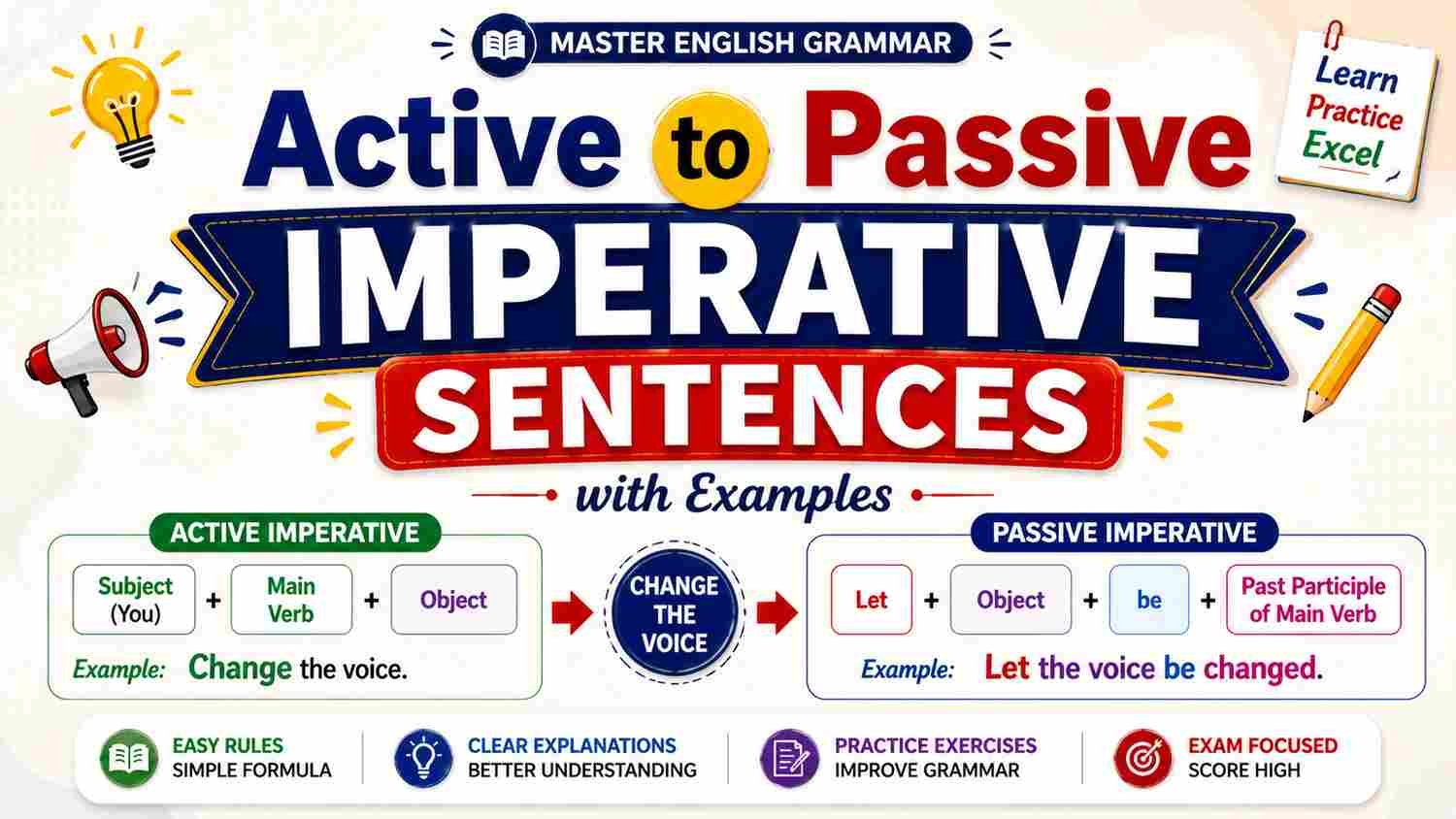
To change from active to passive imperative sentences, we must follow some simple steps. Active to passive imperative sentences are an important part, as far as voice change is concerned in English Grammar.
Explore these detailed guides to understand voice change rules and sentence transformation more clearly:
We find active to passive imperative sentences frequently in different board exams as well as competitive exams. If you are looking for how to convert an active sentence to the passive voice of imperative sentences, this article will satisfy your query.
What is an imperative sentence?
When a sentence expresses a request, order, or advice, we may call this an imperative sentence.
The subject of an imperative sentence will be in the 2nd person (You), and this remains understood, i.e., we do not write the subject. For example,
- (You) Please give me a glass of water. (request)
- (You) Obey your parents. (advice)
- (You) Don’t make noise. (order)
- (You) Go there. (order) (without object)
Sometimes an imperative sentence begins with ‘Let‘. For Example,
- Let us do it.
- Let me have a cup of coffee.
- Let’s play football.
Rules to convert Active to Passive Imperative Sentences
Basically, there exist two general rules to convert active to passive Imperative Sentences. For changing Active to Passive Imperative Sentences first, we should look for two points.
- 1st point: imperative sentence with the object.
- 2nd point: imperative sentence without the object.
Conversion of Passive Imperative Sentences with objects
If an active imperative sentence contains an object, the following two formulas may be applied to convert active voice to passive voice.
Formula 1
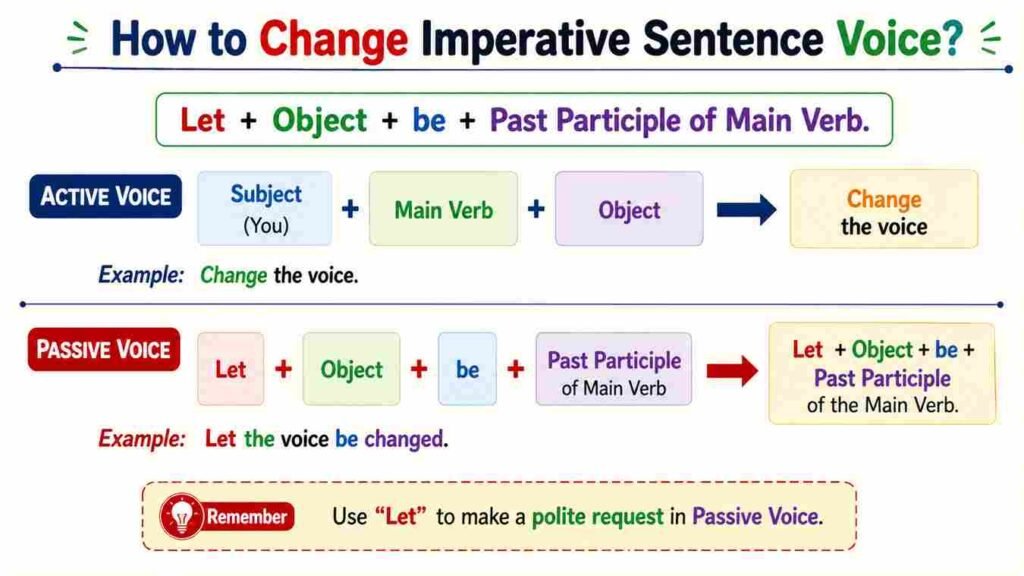
Let + Object +be + Past Participle of Main Verb.
Passive Voice Example with ‘Let’
| Active Voice | Subject (You) | Main Verb | Object |
| Change the voice | _ | Change | the voice |
| Passive Voice | Let | Object | be | Past Participle of Main Verb. |
| Let the voice be changes | Let | the voice | be | Past Participle of the Main Verb. |
Take a look at the following infographic description.
Formula 2
You are told/requested/ordered/advised + to + active imperative sentence part. Whether it will be requested/ordered/advised, depends on the sense of the active imperative sentence. If the sense of the active imperative sentence is not clearly understood, ‘told’ may be used.
Passive voice Example without ‘Let’
| Active Voice | Subject (You) | Main Verb | Object |
| Change the voice | _ | Change | the voice |
| Passive Voice | You are told/requested/ordered/advise | to | active imperative sentence part. |
| You are told to change the voice. | You are told | to | change the voice |
Read these important examples and exercises on active and passive voice to improve sentence transformation skills:
Imperative sentences voice change examples
| Active Voice | Passive Voice |
| Do it. | You are ordered to do it./ Let it be done. |
| Put out the light. | Let the light be put out. |
| Let me do my duty. | Let my duty be done by me. |
| Tell him to do his duty. | Let him be told to do his duty. |
| Don’t spoil the game. | Let not the game be spoiled. |
| Let the girl sing a song. | Let a song be sung by the girl. |
| Let me tell the truth | Let the truth be told by me /I may be allowed to tell the truth. |
| Let him work out the sum accordingly. | Let the sum be worked out accordingly by him. |
| Never disobey your superiors. | You are asked never to disobey your superiors. / Let your superiors never be disobeyed. |
| Keep off the wild beasts. | You are told to keep off the wild beasts. / Let the wild beasts be kept off. |
Active to Passive Imperative Sentences without objects
For imperative sentences without objects, ‘have‘, ‘put‘, ‘should‘, and ‘You are requested/ordered/advised/told…..’ are to be used.
‘Let’ is never used to convert active to passive imperative sentences without objects
Active to Passive Imperative Sentences Examples without objects
| Active Voice | Passive Voice |
| Keep your promise. | Your promise should be kept. |
| Put up a tent here. | Have a tent put up here. |
| Enter by this gate. | You are requested to enter by this gate. |
| Please keep up the green. | You are requested to keep up the green. |
| Spread the bed cover on the bed. | Have the bed cover spread on the bed. |
| Consider for a moment. | you are requested to consider for a moment. |
| Don’t make a noise here | you are told not to make a noise hair. |
| Have a Cup of tea and take a break. | You are requested to have a cup of tea and take a break. |
| Come in, please. | You are requested to come in kindly. |
| Don’t break with your friend, Harris, please. | Harris is kindly requested not to break with his friend. / Harris is kindly forbidden to break with his friend. |
| Don’t let him walk fast, please. | You are politely requested not to let him walk fast. |
| Cease fire, the army officers | The army officers are directed to a cease fire. |
Active to Passive Imperative Sentences Exercises
Exercise 1
Change the following sentences into passive voice.
1. Clean the dishes.
2. Answer the question.
3. Submit the report.
4. Finish the project.
5. Close the door.
6. Water the plants.
7. Feed the pets.
8. Complete the assignment.
9. Send the email.
10. Turn off the lights.
11. Prepare the presentation.
Exercise 2
Turn the following sentences into passive voice.
1. Do not lose your temper.
2. Please don’t do this again.
3. Keep away from evil company.
4. Change the voice.
5. Leave the room by this door.
6. Repair your Calculator.
7. Keep your promise.
8. Keep away from evil company.
9. Keep away from evil company.
10. Let him work out the sum accordingly.
Explore these detailed guides to understand interrogative, imperative, and optative sentence transformation in passive voice:
- Passive Voice of (Interrogative Sentences)
- Active to Passive (Imperative Sentences)
- Passive Voice of (Optative sentences)
Exercise 3
Change the following into active voice.
1. The dishes should be cleaned.
2. The question should be answered.
3. The report should be submitted.
4. The project should be finished.
5. The door should be closed.
6. The plants need to be watered.
7. The pets should be fed.
8. The assignment must be completed.
9. The email needs to be sent.
10. The lights should be turned off.
11. The presentation must be prepared.
Exercise 4
Change the voice to passive.
1. Let’s prepare the presentation.
2. Let’s answer the question.
3. Let’s feed the pets.
4. Let’s complete the report.
5. Let’s clean the dishes.
6. Let’s finish the project.
7. Let’s send the email.
8. Let’s turn off the lights.
9. Let’s complete the assignment.
10. Let’s water the plants.
Exercise 5
Change the following into active voice
1. The presentation should be prepared.
2. The question must be answered.
3. The pets need to be fed.
4. The report should be completed.
5. The dishes must be cleaned.
6. The project should be finished.
7. The email needs to be sent.
8. The lights should be turned off.
9. The assignment must be completed.
10. The plants need to be watered.
Read these class-wise voice change exercises and grammar guides prepared for different school levels:
- Voice Change Class 10
- Voice Change Class 9
- Voice Change Class 8
- Voice Change Class 7
- Voice Change Class 6
- Voice Change Class 5
FAQs on Active to Passive Imperative Sentences
Ans: The most common formula is:
Let + Object + be + Past Participle
Example:
Open the door. → Let the door be opened.
Ans: “Let” is used when the imperative sentence contains an object.
Example:
Finish the work. → Let the work be finished.
Ans: Yes. We use Let not or You are told/requested not to.
Example:
Don’t make noise. → You are told not to make noise.
Ans: Yes, but “Let” is usually not used. Structures like should, have, or You are requested to are used instead.
Example:
Enter by this gate. → You are requested to enter by this gate.
Ans: Common words are:
Let
should
have
requested
ordered
advised
told
Ans: Active to passive imperative sentences are frequently asked in:
School examinations
Board exams
Competitive exams
Grammar practice tests
So students should practice the rules and structures carefully.