
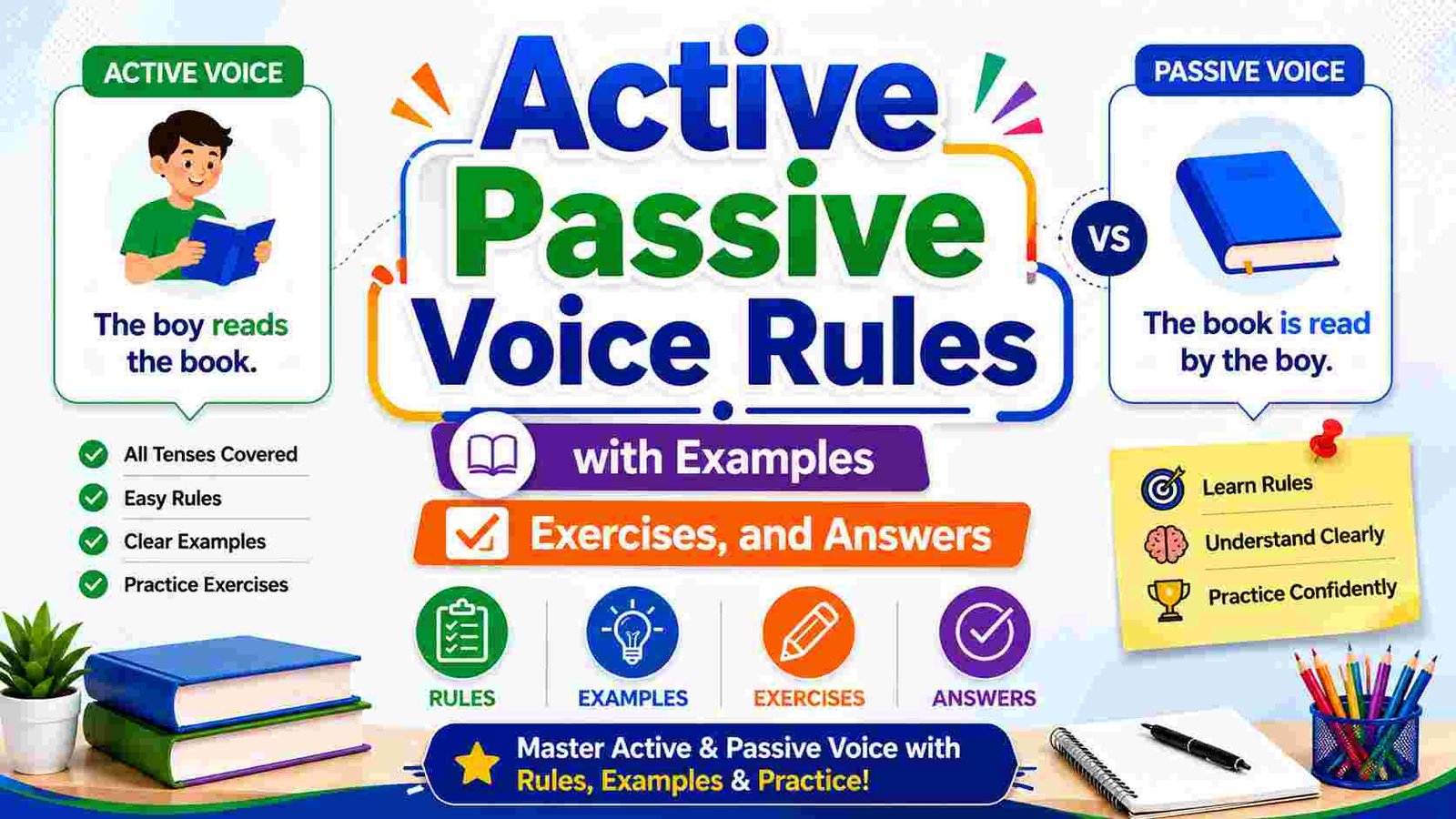
Learning Active Passive Voice Rules is important for clear communication and good content writing in English. Here, I have discussed Active Passive Voice Rules with examples and exercises to help learners easily switch between the two.
Active and Passive Voice: English Grammar
Voice is the form of the verb that shows whether the subject (person or thing) of the sentence is active (does something) or passive (something is done to him or her or it) in the action.
Examples:
(1) The teacher rebuked me.
(2) I was rebuked by the teacher.
The form of the verb of the first sentence shows that the subject (the teacher) is active i.e. he/ she does something (rebuked).
When the subject is the doer of an action, it is the active subject. And the form of the verb is in the active voice.
The form of the verb in the second sentence shows that the subject (I) is passive i.e. something is done to him/her (was rebuked).
When the subject inactively receives an action (was rebuked), it is in the passive voice. And the verb form is in Passive voice.
There are two types of voice in English Grammar.
- Active Voice
- Passive Voice
1. What is Active Voice?
When the verb form indicates that the subject of the sentence does something or is in action, we can say the sentence is in Active Voice.
Examples,
(a) I eat rice.
(b) They play football
(c) He made the doll.
(d) You are driving the car.
Students can also practise easy sentence transformation from this guide on Class 7 Voice Change Exercises and Answers.
2. What is Passive Voice?
When the verb form indicates that the subject of the sentence remains inactive or is in inaction, we can say the sentence is in Passive Voice. For
Examples,
(a) Rice is eaten by me.
(b) Football is played by them.
(c) The doll was made by him
(d) The car is being driven by you.
Active And Passive Voice Rules: All Tenses.
Explore the active and passive voice rules for all tenses, providing examples and exercises to master the art of active passive voice conversion for English language skills.
Active Passive Voice Present Tense Rules, Structure, and Examples:
| Active Voice Examples | Passive Voice Structure | Passive Voice Examples | |
| Indefinite | I play football. | S+ am/is/are+ V(P-P)+ by + O | Football is played by me. |
| Continuous | We are playing football. | S+ am/is/are+ being +V(P-P)+ by+ O | Football is being played by me. |
| Perfect | He has played football. | S+ has/have+ been +V(P-P)+ by+ O | Football has been played by me. |
| Perfect Continuous | They have been playing football. | S+ has/have+ been + being + V(P-P)+ by + O | Football has been being played by me. |
Examples:
Active: I eat rice.
Passive: Rice is eaten by me.
Active: He beats you.
Passive: You are beaten by him.
Active: I am eating rice.
Passive: Rice is being eaten by me.
Active: He is writing a letter.
Passive: A letter is written by him.
Active: I have eaten rice.
Passive: Rice has been eaten by me.
Active: He has written a letter.
Passive: A letter has been written by him.
Active: I have been eating rice.
Passive: Rice has been being eaten by me.
Active: He has been writing a letter.
Passive: A letter has been being written by him.
Active Passive Voice Past Tense Rules, Structure, and Examples:
| Active Voice Examples | Passive Voice Structure | Passive Voice Examples | |
| Indefinite | I played football. | S+ was/were+ V(P-P)+ by + O | Football was played by me. |
| Continuous | We were playing football. | S+ was/were+ being +V(P-P)+ by+ O | Football was being played by me. |
| Perfect | He had played football. | S+ had+ been +V(P-P)+ by+ O | Football had been played by me. |
| Perfect Continuous | They had been playing football. | S+ had + been + being + V(P-P)+ by + O | Football had been being played by me. |
Examples:
Active: I ate rice.
Passive: Rice was eaten by me.
Active: He rebuked you.
Passive: You were rebuked by him.
Active: I was eating rice.
Passive: Rice was being eaten by me.
Active: We were making noise.
Passive: Noise was being made by us.
Active: I had eaten rice.
Passive: Rice had been eaten by me.
Active: We had made mistakes.
Passive: Mistakes had been made by us.
Active: I had been eating rice.
Passive: Rice had been being eaten by me.
Active: He had been writing a letter.
Passive: A letter had been being written by him.
Active Passive Voice Future Tense Rules, Structure, and Examples:
| Active Voice Examples | Passive Voice Structure | Passive Voice Examples | |
| Indefinite | I shall play football. | S+ shall be / will be+ V(P-P)+ by + O | Football will be played by me. |
| Continuous | We will be playing football. | S+ shall be / will be+ being V(P-P)+ by + O | Football will be being played by me. |
| Perfect | He will have played football. | S+ shall have/will have+ been +V(P-P)+ by+ O | Football will have been played by me. |
| Perfect Continuous | They will have been playing football. | S+ shall have / will have + been + being + V(P-P)+ by + O | Football will have been being played by me. |
Examples:
Active: I shall eat rice.
Passive: Rice will be eaten by me.
Active: He will rebuke you.
Passive: You will be rebuked by him.
Active: I shall be eating rice.
Passive: Rice will be being eaten by me.
Active: He will be writing a letter.
Passive: A letter will be written by him.
Active: I shall have eaten rice.
Passive: Rice will have been eaten by me.
Active: He will have written a letter.
Passive: A letter will have been written by him.
Active: I shall have eaten rice.
Passive: Rice will have been eaten by me.
Active: He will have written a letter.
Passive: A letter will have been written by him.
Active and Passive Voice Changing Rules for Pronouns
| Subject Pronoun | Object Pronoun | Possessive Pronoun |
| I | me | my |
| We | us | our |
| You | you | your |
| He | him | his |
| She | her | her |
| They | them | their |
| Ravi | Ravi | Ravi’s (his) |
N.B – There will be no change of 'Nouns' in terms of Subject and Object from Active to Passive Voice.
Active and Passive Voice Conversion Rules of Assertive Sentences
Active and passive voice are two different ways to construct sentences in English. The choice between them depends on the emphasis you want to give to the subject or object of the sentence. Let’s explore the fundamental Active Passive Rules for each:
Rule 1: Find out the Subject, Verb, and Object
In the first step, find out the subject, Verb, and Object of the sentences you have to change from active to passive voice.
Examples
1. She(Subj) was singing (Verb) a song (Obj).
2. John (Subj) eats(Verb) rice(Obj).
Rule 2: Identify the ‘Tense and its form’, and ‘Voice‘
In the second step, identify the ‘Tense and its form’, and ‘Voice‘ of the given sentences.
Examples
1. She(Subj) was singing (Verb) a song (Obj). – Past Continuous Tense, Active voice
2. John (Subj) eats(Verb) rice(Obj). – Simple Present Tense Tense, Active voice
We can pick out 'Tense and its form', and 'Voice' from the 'Main Verb' of the given sentences.
Rule 3: ‘object’ of the ‘active voice’ becomes ‘subject’ of the ‘passive voice’.
In the third step, to turn the above-given sentences into the passive voice, write the ‘object’ of the ‘active voice’ as the ‘subject’ of the ‘passive voice’ at the beginning.
Examples
1. She(Subj) was singing (Verb) a song (Obj). – Past Continuous Tense, Active voice
Ans: A song …………………
2. John (Subj) eats(Verb) rice(Obj). – Simple Present Tense Tense, Active voice
Ans: Rice …………………
Rule 4: Put Auxiliary Verbs as (am/is/are/has/have/was/were/had/shall be/will be)
In the fourth step, Auxiliary Verbs as (am/is/are/has/have/was/were/had/shall be/will be) with ‘Being’ or ‘Been’ (where necessary) according to ‘Tense and its forms’, and ‘Passive Subjects’ come before the Main Verb in the Passive Sentence. For example,
Examples
1. She(Subj) was singing (Verb) a song (Obj). – Past Continuous Tense, Active voice
Ans: A song was being …………………
2. John (Subj) eats(Verb) rice(Obj). – Simple Present Tense Tense, Active voice
Ans: Rice is …………………
Active Passive Voice Rules Chart: Auxiliary Verbs
| Active Voice | Passive Voice |
| eat/eats | am/is/are eaten |
| am/is/are eating | am being/is being/are being eaten |
| has/have eaten | has been/have been eaten |
| has been/have been eating | has been being/have been being eaten |
| ate | was/were eaten |
| was/were eating | was being/were being eaten |
| had eaten | had been eaten |
| had been eating | had been being eaten |
| shall/will eat | shall be/will be eaten |
| shall be/will be eating | shall be being/will be being eaten |
| shall have/will have eaten | shall have been/will have been eaten |
| shall have been/will have been eating | shall have been being/will have been being eaten |
Understanding verb forms is important for voice change. Learn more from these 12 Different Types of Active Passive Voice Verbs in Sentences.
Rule 5: Apply the past-participle form of the main verb
In the fifth step, write the past-participle form of the main verb of the active sentence immediately after the auxiliary verb in the passive sentence. Study the following infographic description for example.
Examples
1. She(Subj) was singing (Verb) a song (Obj). – Past Continuous Tense, Active voice
Ans: A song was being sung …………………
2. John (Subj) eats(Verb) rice(Obj). – Simple Present Tense Tense, Active voice
Ans: Rice is eaten …………………
Rule 6: Use a preposition after the main verb
In the sixth step, a ‘preposition’ comes after the main verb in the passive sentence. Generally, in most cases, we use the preposition, ‘by’ but there are some exceptions.
Examples
1. She(Subj) was singing (Verb) a song (Obj). – Past Continuous Tense, Active voice
Ans: A song was being sung by …………………
2. John (Subj) eats(Verb) rice(Obj). – Simple Present Tense Tense, Active voice
Ans: Rice is eaten by …………………
Rule 7: ‘Subject’ of the ‘active voice’ becomes ‘Object’ of the ‘passive voice’
In the final step, to turn the above-given sentences into the passive voice, write the ‘Subject’ of the ‘active voice’ as the ‘Object’ of the ‘passive voice’ at the end of the sentence. Study the following infographic description for example.
Examples
1. She(Subj) was singing (Verb) a song (Obj). – Past Continuous Tense, Active voice
Ans: A song was being sung by her. – Passive Voice
2. John (Subj) eats(Verb) rice(Obj). – Simple Present Tense Tense, Active voice
Ans: Rice is eaten by John. – Passive Voice
Rules to Transform Passive into Active Voice
Rule 1: Identify the Subject, Object, and Doer
In a passive voice sentence, the object receives the action, and the doer of the action is optional and may not be explicitly mentioned. To convert it into active voice, identify the subject, object, and doer (if provided) in the sentence.
Example:
Passive Voice: “The book (object) was written (verb) by the author (doer).”
Active Voice: “The author (doer) wrote (verb) the book (object).”
Rule 2: Determine the Appropriate Verb
In active voice, the subject performs the action, so choose an appropriate verb that aligns with the subject’s action.
Example:
Passive Voice: “The presentation (object) was given (past tense of ‘give’) by Sarah (doer).”
Active Voice: “Sarah (subject) gave (past tense of ‘give’) the presentation (object).”
Rule 3: Change the Verb Tense
In passive to active voice transformation, adjust the verb tense according to the context and subject’s action.
Example:
Passive Voice: “The cake (object) will be baked (future tense of ‘bake’) by the baker (doer).”
Active Voice: “The baker (subject) will bake (future tense of ‘bake’) the cake (object).”
Active Passive Voice Rules for Interrogative Sentences
To change the active voice into the passive voice of an interrogative sentence, we must follow the simple rules.
Rules:
1. Auxialary Verb + subject + main verb (past-participle form) + by + object?


2. Wh-word + Auxialary Verb + subject + main verb (past-participle form) + by + object?
Examples:
Active: Do I eat rice?
Passive: Is eaten by me?
Active: Are you eating rice?
Passive: Is rice being eaten by me?
Active: Have you eaten rice?
Passive: Has rice been eaten by you?
Active: Where did Anil find the bag?
Passive: Where was the bag found by Anil?
Active: How did you open the door?
Passive: How was the door opened by you?
For school-level practice, read these Active Passive Voice Class 8 Questions and Answers.
Active Passive Voice Rules for Modal Auxilary Verbs
Subject + Modal Auxilary Verb + be + Main Verb (past-participle form) + by + Object.
Examples
Active: I can do this work.
Passive: This work can be done by me.
Active: You may help your brother.
Passive: Your brother may be helped by you.
Active Passive Voice Changing Rules for Complex Sentences
In case of active to passive voice change of complex sentences, if both the Principal Clause and Subordinate Clause consist of transitive verbs.
- We have to change The transitive verbs of both the Principal clauses and Subordinate Clauses.
- Sometimes we need to use Introductory ‘it’.
Examples:
Active Voice: I know that he did the work
Passive Voice: It is known to me that the work was done by him./That the work was done by him is known to me.
Active Voice: Everybody says that you have done it.
Passive Voice: It is said by everybody that it has been done by you./That it has been done by you is said by everybody.
Advantages of knowing Active Voice Rules
Using active voice in writing offers several advantages:
1. Clarity: Active voice makes sentences clear and concise, leaving no room for ambiguity.
2. Engagement: It creates a sense of directness, engaging readers and keeping them interested.
3. Impact: Active voice can give your writing a more powerful and persuasive tone.
4. Efficiency: It often requires fewer words to convey the same message compared to passive voice.
Advantages Passive Voice Rules
Passive voice also serves specific purposes and offers benefits, such as:
1. Focus on the Action: By omitting the doer of the action, passive voice keeps the focus on what happened, not who did it.
2. Formality: In formal writing, passive voice can be more appropriate and professional.
3. Anonymity: When the doer is unknown or irrelevant, passive voice can be the preferred choice.
Uses of Passive Voice Rules in English Writing
We use Passive voice in the following situation
1. when we do not know who has done the action:
Example: My pocket has been picked. [who has stolen my purse is not known.]
2. the action done is more important than knowing who has done it.
Example: English is accepted as a global language.
3. In situations of social and historical significance.
Example: America was discovered by Columbus.
4. In Newspaper Report.
Example: Delhi was lashed by a thundershower on Monday evening.
5. To describe a Process.
Example: A mango pickle is prepared with the following steps.
6. In invitation, request, and announcement.
Example: Passengers are requested to keep a safe distance.
Work out Examples of Active to Passive Voice
| Active Voice | Passive Voice |
| 1.Ram kills a frog. | 1. A frog is killed by Ram. |
| 2. I am doing the work. | 2. The work is being done by me. |
| 3. I have drawn the picture. | 3. The picture has been drawn by me. |
| 4. He has been building a new house in the town. | 4. A new house has been being built in the town by him. |
| 5. Harris read a book. | 5. A book was read by Harris. |
| 6. They were playing football. | 6. Football was being played by them. |
| 7. You had finished the home task. | 7. Home task had been finished by you. |
| 8. They had been doing the work for 3 hours. | 8. The work had been being done for 3 hours by them. |
| 9. I shall give you a pen. | 9. A pen will be given to you by me. |
| 10. They will be carrying loads. | 10. Loads will be being carried by them. |
| 11. We will have done the work. | 11. The work will have been done by us. |
| 12. The children will have been playing football for 2 hours tomorrow. | 12. Football will have been being played by the children for 2 hours tomorrow. |
Before solving the exercises below, you can also practise with these 25+ Active and Passive Voice Exercises with Answers (2025).
Exercises of Active to Passive Voice
A. Change the following into passive Voice.
1. They play cricket.
2. They are beating the man mercilessly.
3. John has obtained high marks.
4. The worker has been doing work for 3 hours.
5. The girl threw a stone.
6. Children were sucking oranges.
7. Virat Kohli declared the end of the innings after Rohit Sharma had scored his century.
8. The boy had been doing his Homer for half an hour.
9. Shefali will buy a bag.
10. The farmers will be catching fish.
11. Anirban will have retained the Nobel by this time.
12. They will have been finishing the task by that time.
13 . Naveen does not look at the moon.
14. Sonali is not eating an Apple.
15. Tania has not composed a poem.
16. The man has not been driving the car for 2 hours.
17. We did not kill a Tiger.
18. The boy was not throwing stones at the frog.
19. I had not written the letter before he came.
20. They had not been playing football for 3 hours.
21. You will not get the price.
22. Father will not be reading the newspaper in the morning.
23. Mother will not have finished cooking before father comes.
24. They will not have been making noise before the teacher arrives
Want more sentence transformation practice? Check out these 99+ Active Voice and Passive Voice Examples with Answers for better understanding.
FAQs on Active Passive Voice Rules
Ans: Active voice is a form of sentence in which the subject performs the action. Example: Rahul writes a letter.
Ans: Passive voice is a form of sentence in which the subject receives the action. Example: A letter is written by Rahul.
Ans: To change active voice into passive voice, identify the subject, verb, and object, then make the object the subject and use the correct auxiliary verb with the past participle form.
Ans: Passive voice is used when the action is more important than the doer or when the doer is unknown.
Ans: No. Only sentences with transitive verbs and objects can usually be changed into passive voice.
Ans: Passive voice generally contains a form of “be” verb and the past participle (V3) form of the main verb.
Ans: Passive voice is used in scientific writing to focus more on the result or process than on the person performing the action.
Ans: You can improve your skills by practising sentence transformation, learning tense structures, and solving active-passive voice exercises regularly.
Conclusion:
Mastering active and passive voice is essential for effective communication and writing in English. By understanding the rules and practicing with examples and exercises, you can confidently use both forms to enhance the clarity and impact of your writing. So go ahead and incorporate active and passive voice into your linguistic toolkit to elevate your language skills to new heights!