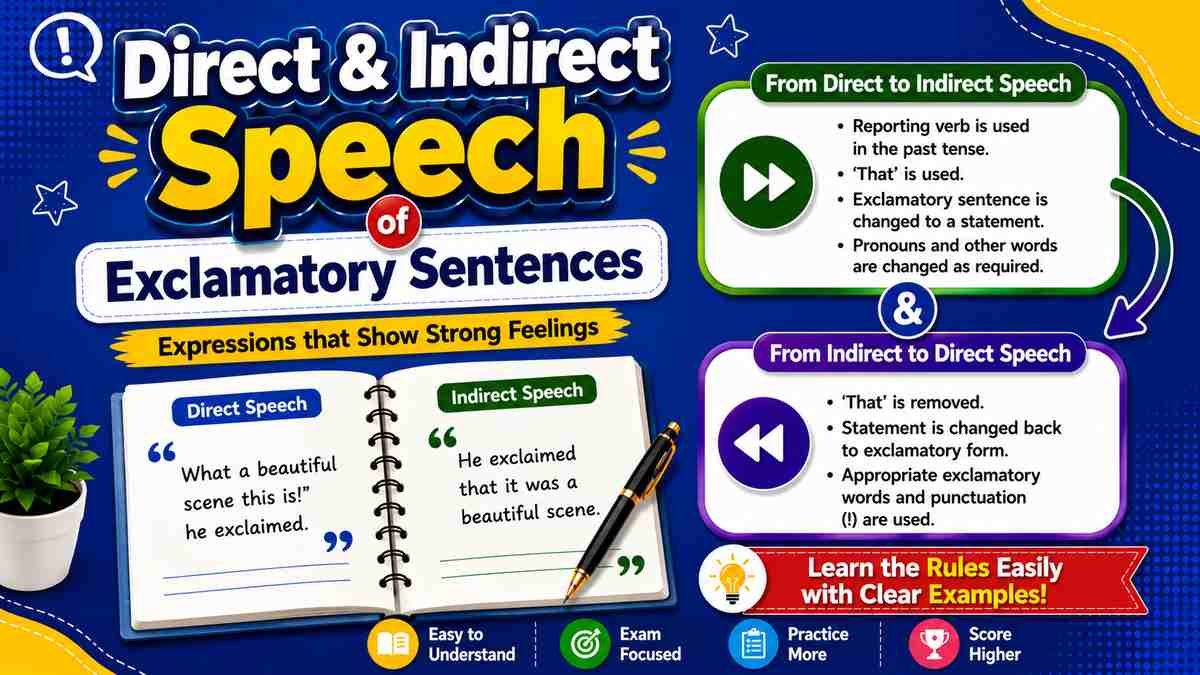
Direct and Indirect Speech of Exclamatory Sentences is a must-know English grammatical topic for English learners. Here, I have tried to explain what Direct and Indirect Speech of exclamatory sentences are and how to change, transform, or convert direct speech to Indirect Speech of an exclamatory sentence.
Exclamatory Sentences: Direct Speech in English
An exclamatory sentence is a type of sentence that expresses strong emotion, surprise, or emphasis. It often ends with an exclamation mark (!). These sentences can express a wide range of emotions, including joy, amazement, anger, frustration, or sorrow. Sometimes, the speaker needs to convey their speech using exclamatory sentences, and this is the direct speech of exclamatory sentences.
For example:
- Direct Speech: The visitor said, “Wow, what a beautiful day!”
- Direct Speech: He said, “What a terrible mistake!”
- Direct Speech: The lady said, “How amazing!“
For a better understanding, check the Direct and Indirect Speech Full Concept and Guide
Indirect Speech of Exclamatory Sentences
When the exact speech of the speaker is summarized and conveyed without quotation marks, emphasizing or expressing strong feelings or emotions, it is the indirect speech of exclamatory sentences. They are often used to make a statement stand out in a conversation or text.
Examples,
- Direct: The visitor said, “Wow, what a beautiful day!”
- Indirect: The visitor exclaimed with joy that it was a beautiful day.
- Direct: He said, “What a terrible mistake!”
- Indirect: He exclaimed in dismay that it was a terrible mistake.
- Direct: The lady said, “How amazing!”
- Indirect: The lady exclaimed in wonder that it was very amazing.
Understand Exclamatory Sentences of Direct and Indirect Speech
An Exclamatory Sentence expresses some emotion. The emotion is conveyed through an interjection or an interjectional phrase or some idiomatic touches.
In this type of sentence, there is an exclamation mark (!). This sentence also expresses some emotion or feeling.
Example:
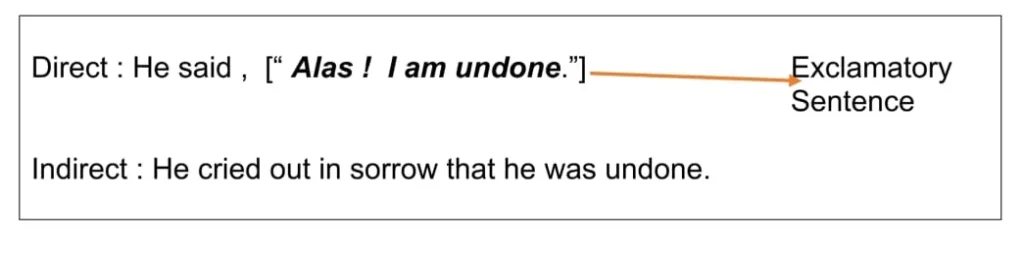
- Direct Speech: He said, “Alas! I am undone.”
- Indirect Speech: He cried out in sorrow that he was undone.
Let’s now consider Direct and Indirect Speech to understand the Rules of Exclamatory Sentences from Direct Narration to Indirect Narration.
Rules for Direct and Indirect Speech of Exclamatory Sentences
Rule 1:
First, try to explore which kind of sentence the reported speech is under, Direct Narration.
Rule 2:
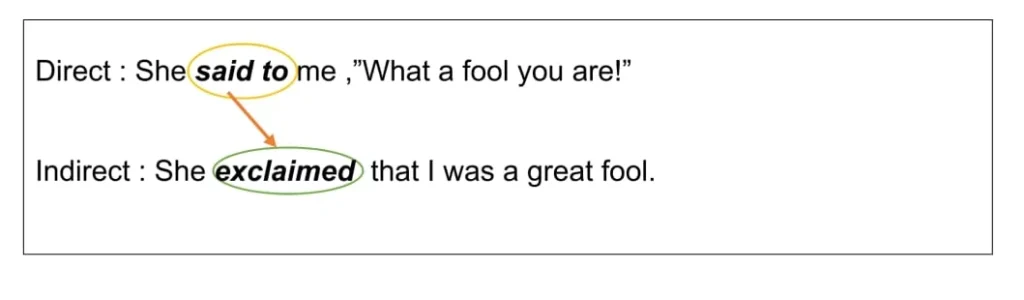
In Indirect Narration, the Interjectional Words or Phrases are omitted, and the emotion is expressed through other words (exclaim, cry out, pray, wish). But new words and phrases have to be introduced to express the full meanings. In General, the Reporting Verbs in Indirect Narration can be like – exclaim (with/in) joy /sorrow, etc.
Rule 3:
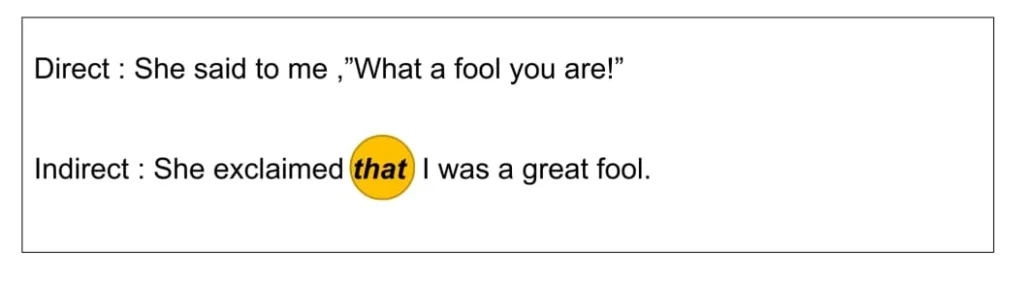
In Indirect Narration, the conjunction “that” is used before the Reported Speech.
Rule 4:
The Note of Exclamation ( ! ) is replaced by a Full Stop ( . ) in Indirect Narration.
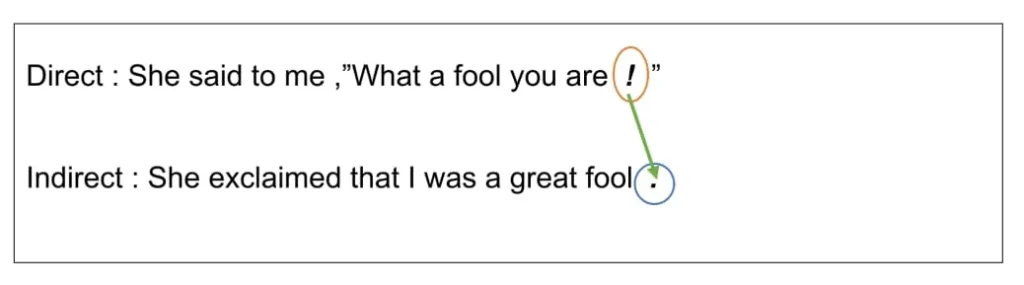
Rule 5:
The next rule is about the Changes in Persons in indirect narration. It is under the General Rule Category. Study and explore the rules.
Also Read:
- Direct and Indirect Speech Rules with Examples
- Direct and Indirect Speech of Assertive Sentences
- Direct and Indirect Speech of Interrogative Sentences
Rule 6:
Changes in Reporting Verb in Indirect Narration and the Verb of the reported speech in indirect narration have also been discussed in the General Rules section on the previous page. It should be carefully studied.
Examples of Direct and Indirect Speech of Exclamatory Sentences
Note the Change of Exclamatory Sentences from Direct Speech to Indirect Speech.
Direct: He said, “Alas! I am undone !”
Indirect: He cried out in sorrow that he was undone.
Direct: He said, “What a fool I am !”.
Indirect: He exclaimed with grief that he was a great fool.
Direct: He said, “Goodbye, my friends.”
Indirect: He bade his friends goodbye. (Or, He bade goodbye to his friends).
Direct: “Bless his kind heart !” they cried.
Indirect: They blessed him for his kind heart.
Direct: “Bravo ! well done !” they cried.
Indirect: They applauded him, for (or saying that) he had done well.
For other Sentences, Direct to Indirect Speech, check here:
- Direct and Indirect Speech of Imperative Sentences
- Direct and Indirect Speech of Optative Sentences
- Direct and Indirect Speech of Exclamatory Sentences
Direct: “So help me Heaven !” he cried, “I will never do so again.”
Indirect: He prayed to Heaven to help him in his resolve not to do so again.
Direct: He said, “By Jove! What good news !”
Indirect: He swore by Jove that it was a piece of very good news.
Direct: The boys said, “Hurrah! We have won the match.”
Indirect: The boys exclaimed in/with joy that they had won the match.
Work Out Examples of Direct and Indirect Speech
Direct: He said to me, “Alas! I could not save you.”
Indirect: He exclaimed in grief that he could not save me.
Direct: The boy said, “What a fool I am!”
Indirect: He exclaimed (cried out) that he was a great fool.
Direct: He said, “What a nice bird it is!”
Indirect: He exclaimed in wonder that it was a very nice bird.
Direct: He observed, “How dirty the house is!”
Indirect: He exclaimed that the house was very dirty.
Direct: “Help! Help!” shouted the woman.
Indirect: The woman shouted for help.
Direct: He said, “Goodbye, my friends!”
Indirect: He bade goodbye to his friends. / He bade his friends goodbye.
Direct: The teacher said, “Thank you, my boys!”
Indirect: The teacher thanked the boys.
Direct: He said, “By Jove! What good news.”
Indirect: He swore by Jove that it was a piece of very good news.
Direct: She said to me, “Happy Christmas.”
Indirect: She wished me a Happy Christmas.
Direct: He said to them, “Bravo! you have done well.”
Indirect: He applauded them saying that they had done well.
Worksheet and Answers of Exclamatory Sentences
Study the following workout examples of exclamatory sentences from Direct speech to Indirect Speech.
Direct: The old man said to him, “Fie! You are such a coward.”
Indirect: The old man exclaimed that it was shameful that he was such a coward.
Direct: He said, “Poor fellow! How changed you are.”
Indirect: He pitied the man and exclaimed that he was greatly changed.
Direct: “So help me Heaven!” he cried, “I’ll never do so again.”
Indirect: He prayed to Heaven to help him and resolved not to do so again.
Direct: He said, “Who knew that this would happen!”
Indirect: He said that none knew that (that) would happen.
Direct: He said, “Good Gracious! What a huge snake.”
Indirect: He exclaimed with wonder that it was a huge snake.
Direct: “Good Heavens! We have reached the station,” said the boys.
Indirect: The boys exclaimed with delight that they had reached the station.
Direct: He said to me, “How happy you are !”
Indirect: He told me that I was very happy.
Direct: He said, “What a nice thing it is !”
Indirect: He said (or exclaimed with joy) that it was a very nice thing.
Direct: He said, “What was my joy to see the thing !”
Indirect: He said that his joy to see the thing was very great.
Direct: I said, “Who knew that this would happen !”
Indirect: I said that none knew that that would happen.
Direct: He said, “Thank you.”
Indirect: He thanked me.
Direct: He said, “Curse the rain.”
Indirect: He cursed the rain.
Direct: He said, “Good morning.”
Indirect: He greeted me (or, wished me) a good morning.
Direct: He said, “Congratulations !”
Indirect: He congratulated me.
For Advanced Direct and Indirect Speech Preparation, Check:
Exercises of Exclamatory Sentences: Direct and Indirect Speech
Turn the following into a Reported Speech of an Exclamatory sentence
1. She said, “Alas! my daughter is lost.”
2. The boys said, “Hurrah! our team has won.”
3. “How happy we were there!” they said.
4. Ram said, “What a beautiful bird I’ve seen!”
5. The poor woman said, “Alas! I’m ruined.”
6. “Good night to you all”. said he.
7. She said, “What a fool you’re!”
8. Puspen said, “How happy I am now!”
9. We all said, “May he live long!”
10. He said to me, “May you succeed.”
11. “What a lazy boy you are!” he angrily remarked.
12. She said, “What a pity you did not come.
13. “Bravo! You’ve played well,” the captain said.
14. He said to his friend, “May God save you.”
15. You said, “Alas! I am ruined.”
16. He said to me, “What a forgetful fellow you are!”
17. The old man said, “How soothing the sunshine is!”
18. She said, “What a disgraceful insult!”
19. The boys said, “Hurrah! Our school team has won the trophy.”
20. Rikta said to her friend, “How happy I am to meet you!”
21. The host said, “Thank you, my guest.”
22. The girl said, “How cruel the man is!”
23. The boy said to me, “Fie! you have stolen my book.”
24. He said to me, “Bravo! it is well done.”
25. Mother said, “How dirty the environment is!”
26. They said, “How glorious the death is!”
27. The soldiers said, “Goodbye, my friends!”
28. You said, “Good morning, Mr. Roy!”
Direct and Indirect Speech of each grade for beginners and intermediate learners, check:
- Narration Change Rules Examples Exercises Class 10
- Narration Change Rules Examples Exercises Class 9
- Narration Change Rules Examples Exercises Class 8
- Narration Change Rules Examples Exercises Class 7
- Narration Change Rules Examples Exercises Class 6
- Narration Change Rules Examples Exercises Class 5
FAQs on the Direct and Indirect Speech of Exclamatory Sentences
1. What is an exclamatory sentence in direct and indirect speech?
Ans: An exclamatory sentence is a sentence that expresses strong emotion, surprise, joy, sorrow, anger, wonder, or emphasis. In direct speech, the exact words of the speaker are written inside quotation marks and usually end with an exclamation mark.
For example, The visitor said, “Wow, what a beautiful day!” In indirect speech, the speaker’s exact words are not used.
The meaning is reported without quotation marks, and the emotion is expressed through words like exclaimed with joy, cried out in sorrow, or exclaimed in wonder.
2. How do you change an exclamatory sentence from direct speech to indirect speech?
Ans: To change an exclamatory sentence from direct speech to indirect speech,
First, identify the sentence inside the quotation marks.
Then remove the interjectional words or phrases like Alas, Hurrah, Bravo, Wow, Fie, etc. The emotion of the sentence should be expressed through suitable words, such as exclaimed with joy, exclaimed in sorrow, cried out, applauded, thanked, wished, or blessed.
The conjunction that is generally used before the reported speech.
The exclamation mark is changed into a full stop.
For example, Direct: He said, “Alas! I am undone.” Indirect: He cried out in sorrow that he was undone.
3. What are the rules for changing exclamatory sentences into indirect speech?
Ans: The main rules for changing exclamatory sentences into indirect speech are as follows. First, find out whether the reported speech is an exclamatory sentence. Secondly, omit the interjectional words or phrases and express the emotion with proper reporting verbs or phrases like exclaim with joy, exclaim in sorrow, cry out, pray, or wish. Thirdly, use the conjunction that before the reported speech. Fourthly, replace the exclamation mark with a full stop. Fifthly, change the persons according to the general rules of narration. The reporting verb and the verb of the reported speech should also be changed where necessary.
4. What are some examples of direct and indirect speech in exclamatory sentences?
Ans: Here are some examples of direct and indirect speech of exclamatory sentences:
Direct: He said, “Alas! I am undone!”
Indirect: He cried out in sorrow that he was undone.
Direct: The boys said, “Hurrah! We have won the match.”
Indirect: The boys exclaimed with joy that they had won the match.
Direct: He said, “What a nice bird it is!”
Indirect: He exclaimed in wonder that it was a very nice bird.
Direct: He said, “Goodbye, my friends!”
Indirect: He bade goodbye to his friends.
Direct: He said to them, “Bravo! You have done well.”
Indirect: He applauded them, saying that they had done well.